How to play
Paddle Smash is table tennis seen from the side, in an old rec room with a hanging lamp. Red plays from the left end of the table and Blue from the right. Hit the ball over the net so that it bounces once on your rival’s half, and make them miss. A game goes to eleven points and you have to win by two. The menu also offers a quick game to five or a long one to twenty-one.
- Red moves with A and D, jumps with W and swings with Space.
- Blue moves with the left and right arrows, jumps with ↑ and swings with Enter.
- Gamepads work too: the stick moves, up jumps and A swings. The first pad is Red, the second is Blue.
- On a phone, hold it sideways. Each player owns one half of the screen: drag to move, drag upwards to jump and tap the paddle button on the outer edge to swing.
- Playing alone? Choose vs Bot and pick Easy, Normal or Hard.
- P or Esc pauses. The game also pauses by itself when you switch tabs.
Timing the swing
You do not aim. Every swing is aimed at your rival’s half for you, high enough to clear the net. What you control is the timing. Your paddle sweeps up and forward, and the middle of the swing is the sweet spot. Swing early and the ball flies long; swing late and it flies low and short. One frame off still lands on the table. Two frames late and the ball goes into the net, and a swing at the very start of its arc sends even a backspin ball past the end of the table.
Bounces and faults
After you hit, the ball has to bounce exactly once on the other half before your rival may hit it back.
- If it lands on your own half, for example after clipping the net, you lose the point.
- If it bounces twice on your rival’s half, or bounces once and then falls to the floor, you win the point.
- If it flies past the table without bouncing on the other half, it is out and you lose the point.
- If your rival hits the ball before it bounces while it is still over the table, you win the point. A ball that has already flown past the end of the table is out, so hitting it there does not save it.
The serve here is the rec room version: the server hits the ball straight over the net, no bounce on their own side first. The ball waits in front of the server. Swing to serve, or the serve goes by itself after three seconds. The serve changes every two points, and every point once the game reaches ten all.
Topspin, backspin and the smash
Hold towards the net as your swing starts and you play topspin: a higher loop that dives down and jumps forward off the table. Hold down and you play backspin: a slow, low ball that stops after it bounces. Jump and hit a ball that is high above the table and you smash it, flat and fast. The ball glows red with topspin and blue with backspin, so you can read it before it lands.
Rally heat
Long rallies get faster. Every fourth return in a row adds speed to the ball, up to about a third faster than normal, and the board above the table fills up. The heat resets after every point.
Strategy
Stand back. The ball rises after it bounces. Standing a step behind the end of the table gives you time to let it come down to your paddle.
Mix the spin. A backspin ball after a topspin one changes the bounce your rival is waiting for.
Smash the high ones. A ball that sits up high over the table is an invitation: jump and hit it before it comes down.
Mind the heat. Late in a long rally the ball is fast. A safe flat return is better than a wild one.
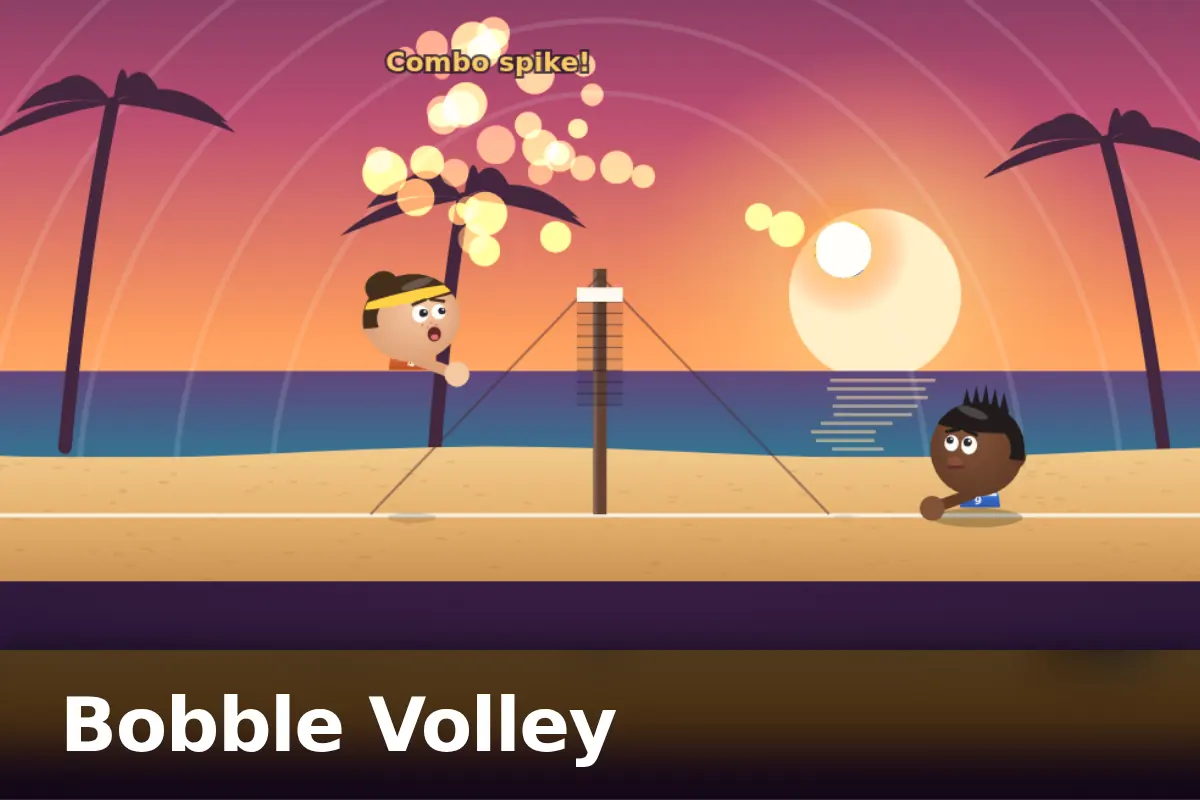
For more two-player sport on one screen, try the big-head beach game Bobble Volley or the neon air hockey of Puck Duel.
If you enjoy Paddle Smash, try Penalty Showdown or Pop Split next.