Blackjack Basic Strategy: The Full Chart Explained
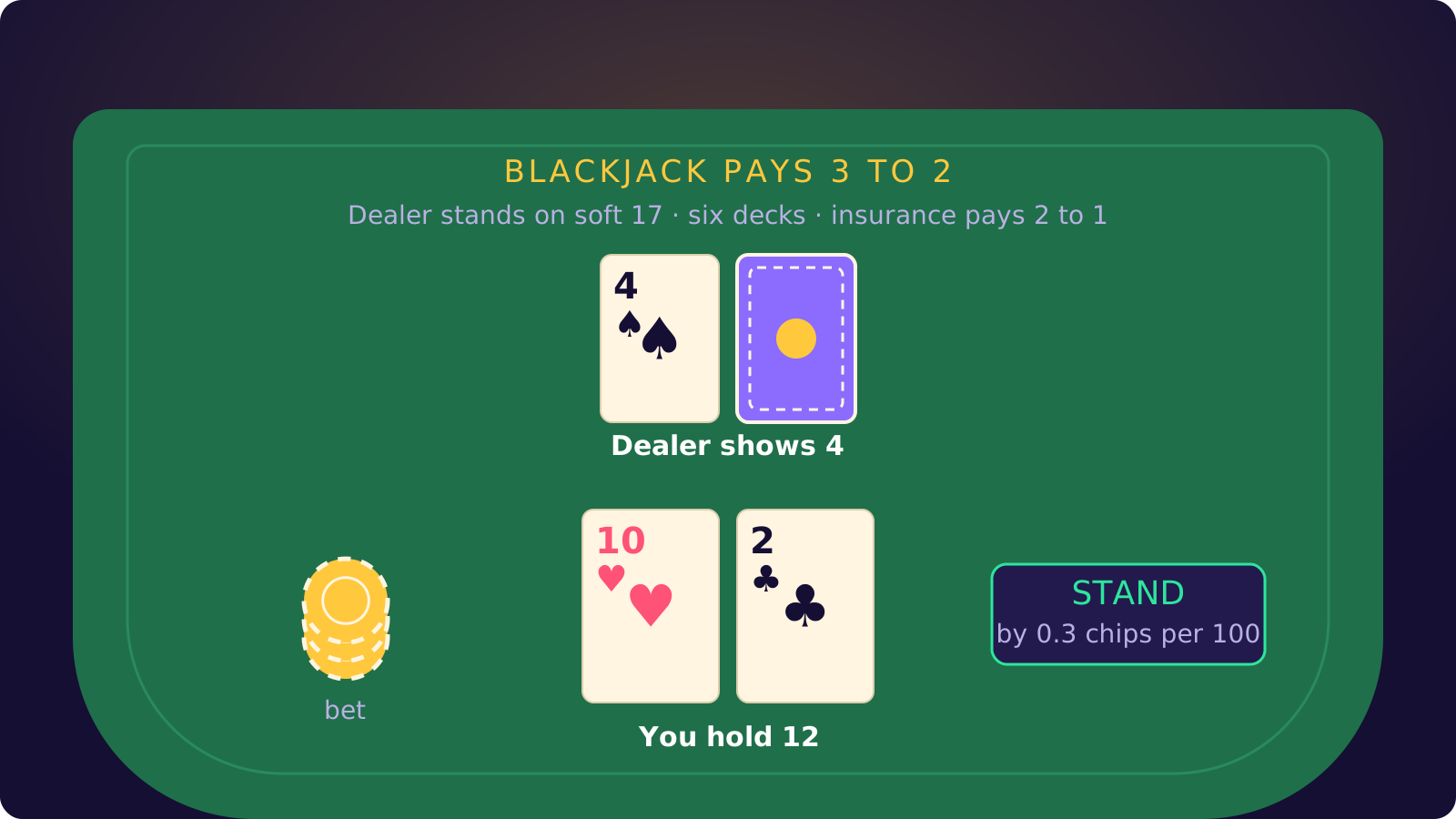
Ten and two against a dealer 4. You have 12, the dealer shows a weak card, and every instinct says take one more. The chart says stand, and it’s right by a hair: at this table standing loses 21.1 chips per 100 bet and hitting loses 21.4. Three tenths of a chip. Most of basic strategy is like that: small edges that add up to the difference between a table that eats your stack and one that barely nibbles it.
This is the complete chart for our Blackjack table, built from the game’s own rules, followed by the reasons behind each region. Every number comes from the solver that powers our charts, run against the rules the game enforces, or straight from the rules with the arithmetic shown.
The rules this chart is built for
Basic strategy is only correct for one set of rules, so here are ours, taken from the game code rather than from memory.
- Six decks. The shoe is reshuffled once fewer than a quarter of the cards remain.
- The dealer stands on soft 17 and draws to 16 or less.
- Blackjack pays 3 to 2. A 21 made after a split is an ordinary 21 and pays 1 to 1.
- You can double on any first two cards, and on each hand after a split. The game page doesn’t spell out doubling after a split, but the code allows it and the chart relies on it.
- Pairs can be split up to four hands. Split Aces get one card each and can’t be split again or doubled. A King and a Queen count as a pair (the chart says don’t split them).
- The dealer checks for blackjack whenever an Ace or a ten is showing. If it’s there, the round ends before you act, so a dealer blackjack only ever takes your original bet, never a double or a split.
- Insurance is offered when the dealer shows an Ace, for half your bet, paying 2 to 1.
- There is no surrender.
Doubling after a split is why 4-4 and 6-6 get split against small cards; no surrender is why 16 against a 10 is a plain hit.
How to read the chart
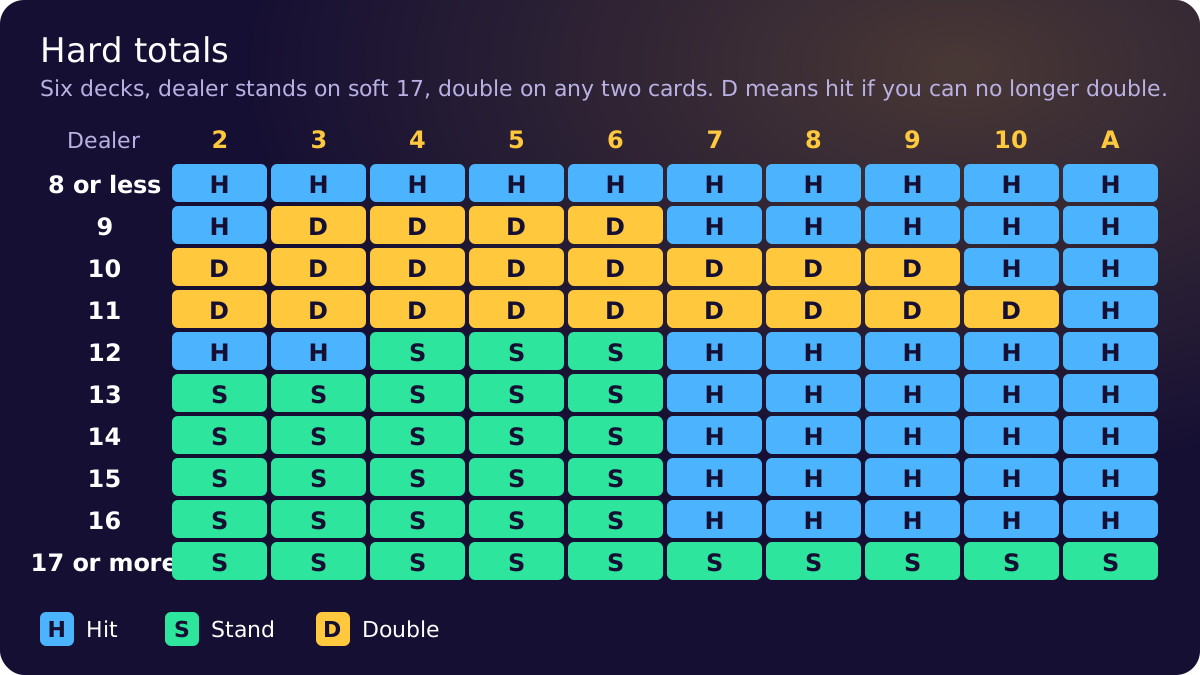
Find your hand in the left column and the dealer’s up card along the top: H is hit, S is stand, D is double (hit if you can’t, because the hand has three cards), Ds is double but stand if you can’t, and P is split.
Check in this order. A pair? Use the pairs table, and if it says don’t split, use the hard or soft table for the same total. Soft, meaning an Ace still counting as 11? Use the soft table. Anything else is a hard total, including a soft hand that has drawn and gone hard.
Hard totals
| Your hand | 2 | 3 | 4 | 5 | 6 |
|---|---|---|---|---|---|
| 8 or less | H | H | H | H | H |
| 9 | H | D | D | D | D |
| 10 | D | D | D | D | D |
| 11 | D | D | D | D | D |
| 12 | H | H | S | S | S |
| 13 to 16 | S | S | S | S | S |
| 17 or more | S | S | S | S | S |
| Your hand | 7 | 8 | 9 | 10 | A |
|---|---|---|---|---|---|
| 8 or less | H | H | H | H | H |
| 9 | H | H | H | H | H |
| 10 | D | D | D | H | H |
| 11 | D | D | D | D | H |
| 12 | H | H | H | H | H |
| 13 to 16 | H | H | H | H | H |
| 17 or more | S | S | S | S | S |
Soft totals
| Your hand | 2 | 3 | 4 | 5 | 6 |
|---|---|---|---|---|---|
| A-2, A-3 | H | H | H | D | D |
| A-4, A-5 | H | H | D | D | D |
| A-6 | H | D | D | D | D |
| A-7 | S | Ds | Ds | Ds | Ds |
| A-8, A-9 | S | S | S | S | S |
| Your hand | 7 | 8 | 9 | 10 | A |
|---|---|---|---|---|---|
| A-2, A-3 | H | H | H | H | H |
| A-4, A-5 | H | H | H | H | H |
| A-6 | H | H | H | H | H |
| A-7 | S | S | H | H | H |
| A-8, A-9 | S | S | S | S | S |
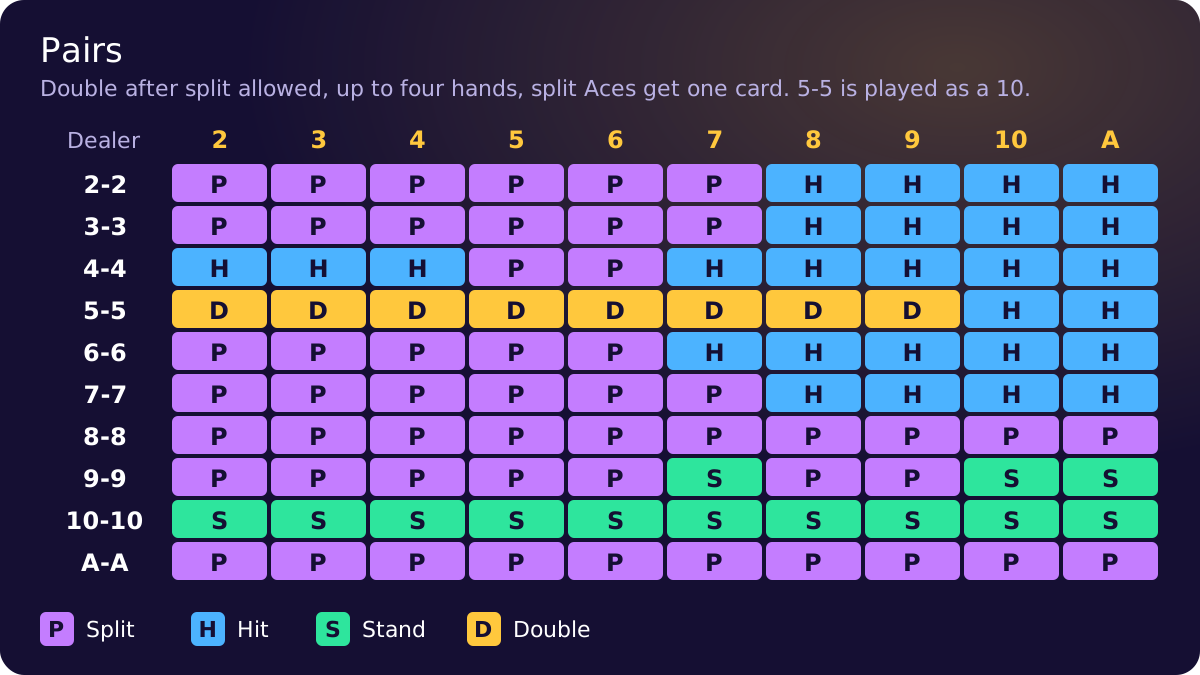
Pairs
| Your hand | 2 | 3 | 4 | 5 | 6 |
|---|---|---|---|---|---|
| 2-2, 3-3 | P | P | P | P | P |
| 4-4 | H | H | H | P | P |
| 5-5 | D | D | D | D | D |
| 6-6 | P | P | P | P | P |
| 7-7 | P | P | P | P | P |
| 8-8, A-A | P | P | P | P | P |
| 9-9 | P | P | P | P | P |
| 10-10 | S | S | S | S | S |
| Your hand | 7 | 8 | 9 | 10 | A |
|---|---|---|---|---|---|
| 2-2, 3-3 | P | H | H | H | H |
| 4-4 | H | H | H | H | H |
| 5-5 | D | D | D | H | H |
| 6-6 | H | H | H | H | H |
| 7-7 | P | H | H | H | H |
| 8-8, A-A | P | P | P | P | P |
| 9-9 | S | P | P | S | S |
| 10-10 | S | S | S | S | S |
One honest footnote. A-2 against a 5 is the closest call on the chart. The classic six-deck answer is double, which is printed above and is what our in-game bot does; our solver, which treats the shoe as endless, has hit ahead by less than a chip per 100. Either is fine.
Why the dealer’s up card decides everything
The chart has two halves because up cards come in two kinds: ones that bust often and ones that don’t. The dealer has no choices, so the odds of each ending follow from the drawing rule. These are our solver’s figures for six decks and stand-on-17, after the dealer has checked for blackjack:
| Up card | Dealer busts | Finishes 17 | Finishes 18 to 21 |
|---|---|---|---|
| 2 | 35.4% | 14.0% | 50.6% |
| 3 | 37.4% | 13.5% | 49.1% |
| 4 | 39.4% | 13.0% | 47.6% |
| 5 | 41.6% | 12.2% | 46.2% |
| 6 | 42.3% | 16.5% | 41.2% |
| 7 | 26.2% | 36.9% | 36.9% |
| 8 | 24.5% | 12.9% | 62.6% |
| 9 | 22.8% | 12.0% | 65.2% |
| 10 | 23.0% | 12.1% | 64.9% |
| A | 16.7% | 18.9% | 64.4% |
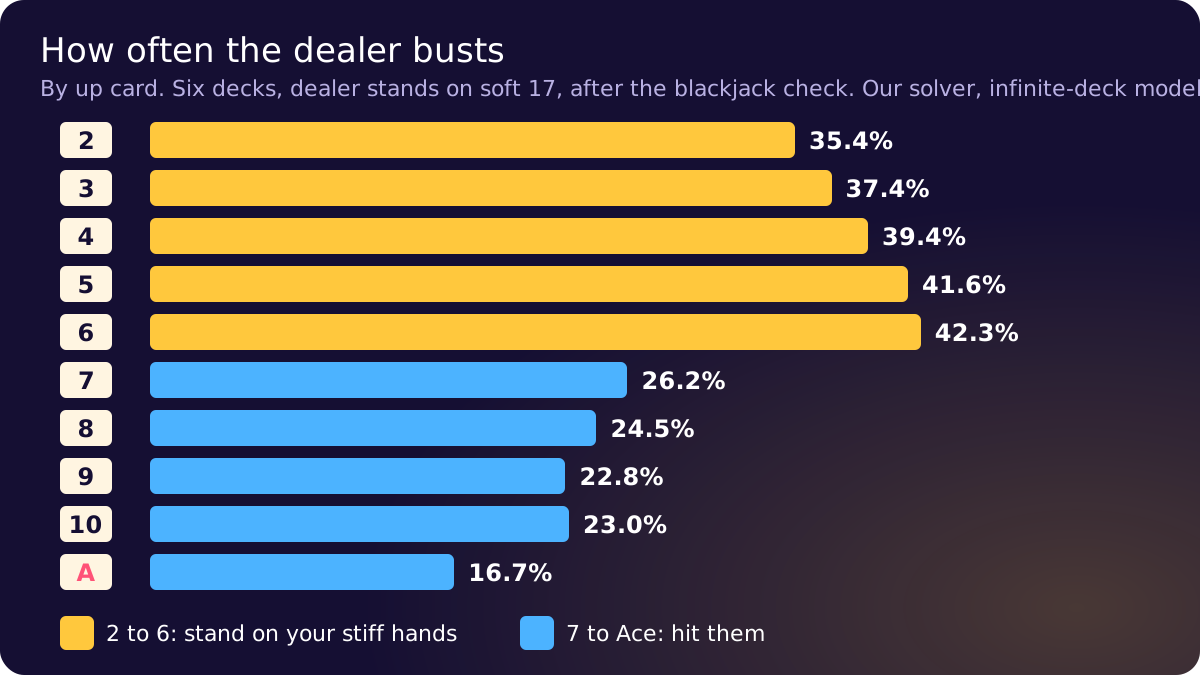
The 10 and Ace rows run higher than tables you may have seen elsewhere. That’s the peek: once the dealer has looked and found no blackjack, the hidden card can’t be the one that would have made it, and what’s left includes a few more busts.
The 6 is the dealer’s worst card, not the 5, and the 17 column says why. A dealer 6 makes a lot of exact 17s (any Ace on top is a soft 17, and the dealer stands on it here), while a 5 keeps drawing through 16. Against 4, 5 or 6 the dealer breaks two times in five. Against 7 and up it’s one in four or worse.
Stand on 12 against 4 to 6, hit it against 2 and 3
A 12 busts on any ten, four cards in thirteen, 31% of the time. Against a 4, 5 or 6 that risk isn’t worth taking when the dealer will break 39% to 42% of the time anyway. Against a 2 or 3 the dealer busts only 35% to 37%, and a standing 12 wins only when they do, so hitting 12 against a 2 loses 25.3 per 100 and standing loses 29.3. At the 4 the lines cross. From 13 up your own bust risk grows (any 9 or higher breaks a 13) and standing wins everywhere from 2 to 6.
Double soft 18 against 3 to 6, hit it against 9, 10 and Ace
Soft 18 feels like a hand to keep. Against a weak card it’s a hand to press: doubling A-7 against a 6 returns 38.2 per 100 where standing returns 28.3, because you can’t bust on the next card and a dealer 6 breaks 42% of the time. Against 9, 10 or Ace a standing 18 loses to the 19s, 20s and 21s those cards make; standing against a 9 loses 18.3 per 100, hitting loses 10.1. Against 2, 7 or 8 you stand.
Never split 10s
A pair of ten-value cards is a 20, the second-best hand you can hold. Against a dealer 6 it wins 70.4 per 100. Two hands that each start from 10 still win, 57.6 per 100, but that’s 12.8 chips thrown away on one of the best spots you’ll see. 5-5 is the same lesson from the other side: a 10 that doubles for 57.6 against a 6, or two 5s, the worst starting card, for 12.4.
Always split Aces and 8s
A-A is a soft 12. Split, it’s two hands that each start from 11, and the gain is enormous: against a 10, splitting returns 18.0 per 100 where hitting the soft 12 loses 7.0. 8-8 is the ugliest pair, a 16 that loses 54.0 per 100 against a 10 whether you hit or stand. Two hands from 8 still lose, 48.9 per 100, but five chips less, and against 2 to 7 they become two hands that win outright. You split 8s because it’s the least bad way out.
Against a 7 the dealer lands on exactly 17 more than a third of the time, so your 18 stands and wins 40.0 per 100; splitting gets 37.0. Against an 8 your 18 would only push the dealer’s likeliest total, so two 9s that can each make 19 beat it, 21.5 to 10.6. Against 10 and Ace, 18 is the better of two poor options.
What the common mistakes cost
Mistakes aren’t equal. Here is what each costs on the hand where it’s made, in chips per 100 bet, from the same solver:
| The mistake | Right play | Cost per 100 |
|---|---|---|
| Splitting 5s against a 6 | Double | 45.2 |
| Not splitting Aces against a 10 | Split | 25.0 |
| Hitting hard 17 against a 10 | Stand | 16.4 |
| Splitting 10s against a 6 | Stand | 12.8 |
| Standing on soft 18 against a 6 | Double | 9.9 |
| Standing on soft 18 against a 9 | Hit | 8.2 |
| Hitting 11 against a 10 | Double | 6.1 |
| Not splitting 8s against a 10 | Split | 5.1 |
| Standing on 12 against a 2 | Hit | 4.0 |
| Doubling 11 against an Ace | Hit | 3.4 |
| Hitting 12 against a 4 | Stand | 0.3 |
The big ones share a shape: they turn a strong or salvageable hand into two weak ones, or skip a double on a hand built for it. The small ones are the stand-or-hit calls on stiff hands. 16 against a 10 is the extreme: in our model hitting and standing both lose exactly 54.0 per 100, a coin landing on its edge. Hit it anyway; a player who always stands on stiff hands against small cards and never doubles soft hands gives up a chip or two per hundred, three or four times the house edge of the whole game.
What insurance really is
Insurance is a separate bet, half your stake, that the dealer’s hidden card is a ten. It pays 2 to 1, so it’s fair only if tens are one third of the cards. They aren’t.
Six decks hold 96 ten-value cards among 312. With the dealer’s Ace and your two cards out, 309 remain, and if neither of yours is a ten, 96 of them are tens: 31.1%. For every 100 chips insured you win 200 on 31.1 hands and lose 100 on 68.9, which nets 62.2 minus 68.9, a loss of 6.8 per 100. Insuring your own blackjack (“even money”) is the same bet in a different costume, and the sure 1 to 1 is worth about 4 chips per 100 less than the 3 to 2.
Decline every time.
The house edge under these rules
Basic strategy at this table leaves the house about half a percent, which is the figure on the game page. Our solver puts the expected result at a loss of 0.57 chips per 100 bet when it models the shoe as endless and ignores re-splitting. Both simplifications make the real figure slightly better for you: cards you’ve seen leave the shoe, and a second split is sometimes worth having. That gap is why our fairness page lists this game’s main bet as depending on your decisions instead of publishing one return to player to six decimals. The paper on the solver sets out what the model does and doesn’t count.
Half a percent means that over 10,000 chips of bets, with perfect play, you’d expect to be down about 50, inside a swing of a few hundred either way. Luck owns any one session; the chart only sets the slow drift underneath. Our chips are virtual and can’t be bought or cashed out, so the drift is the whole point: play well and a stack lasts. The responsible play page explains why we keep it that way.
How to memorise it without the chart
Don’t learn 270 cells. Learn seven rules in priority order and the cells fall out of them.
- Stand on hard 17 and up, and on soft 19 and up.
- Pairs first: always split Aces and 8s, never 10s or 5s. Split 2s, 3s and 7s against 2 to 7; 6s against 2 to 6; 9s against 2 to 9 except 7; 4s only against 5 and 6.
- Double 11 against everything but an Ace, 10 against 2 to 9, 9 against 3 to 6.
- Stiff hands (12 to 16): stand against 2 to 6, hit against 7 to Ace. The one exception is 12, which hits against 2 and 3.
- Soft 18: double against 3 to 6, stand against 2, 7 and 8, hit against 9, 10 and Ace.
- Soft 13 to 17: hit, except double against 5 and 6 (and against 4 from soft 15, against 3 from soft 17).
- Never take insurance.
Rules 1, 3, 4 and 7 cover most hands you’ll be dealt; pairs and soft doubles come up a few times an hour. Deciding well under a sequence of rules is a skill that transfers: our Klondike solitaire strategy guide is built the same way, a priority list where the first rule that applies is the one you follow.
The sibling tables need their own chart
This chart is wrong at our other 21 tables, because the rules move. At European Blackjack the dealer takes no hole card, doubles are limited to 9, 10 and 11, there’s one split, and a dealer blackjack takes your doubles with it, so you double less against a 10 or Ace. Pontoon is a different game wearing the same cards: ties go to the dealer, you can’t stand below 15, and a five-card hand pays 2 to 1. Multi-Hand 21 uses the same six-deck, stand-on-17 rules as this page, plays three hands at once, and shows a strategy hint from the solver described above. The rest of our casino games each have a strategy section on the game page.
Ready to test it? Open Blackjack with this page in another tab, look up every hand for a session, and watch how often the “obvious” play is the one the chart says to avoid.
Frequently asked questions
Who invented blackjack basic strategy?
Four US Army mathematicians, Roger Baldwin, Wilbert Cantey, Herbert Maisel and James McDermott, published the first correct basic strategy in 1956 in the Journal of the American Statistical Association, working the figures out on desk calculators. Edward Thorp later checked and refined their numbers by computer. Today the same decisions come out of solvers like the one behind our charts.
Does basic blackjack strategy work online?
Yes, as long as the online game uses the rules the chart was built for. Our Blackjack table deals from a six-deck shoe with the dealer standing on soft 17, which is exactly what the chart on this page assumes. A table that hits soft 17, pays 6 to 5 or forbids doubling after a split needs a slightly different chart.
Is blackjack basic strategy profitable?
No. Basic strategy is the best possible play without counting cards, and it still leaves the house a small edge, about half a percent on our table. It makes you lose as slowly as the rules allow, it does not make you win. At DiceGem the chips are virtual, so the only thing at stake is how long a stack lasts.
How to practice blackjack basic strategy?
Play with the chart next to you and look up every hand before you act, until the hard-total rows no longer need checking. Then cover the chart and only peek when a soft hand or a pair comes up. A few hundred hands at a free table is enough for the common rows; the rare soft doubles take longer to stick.