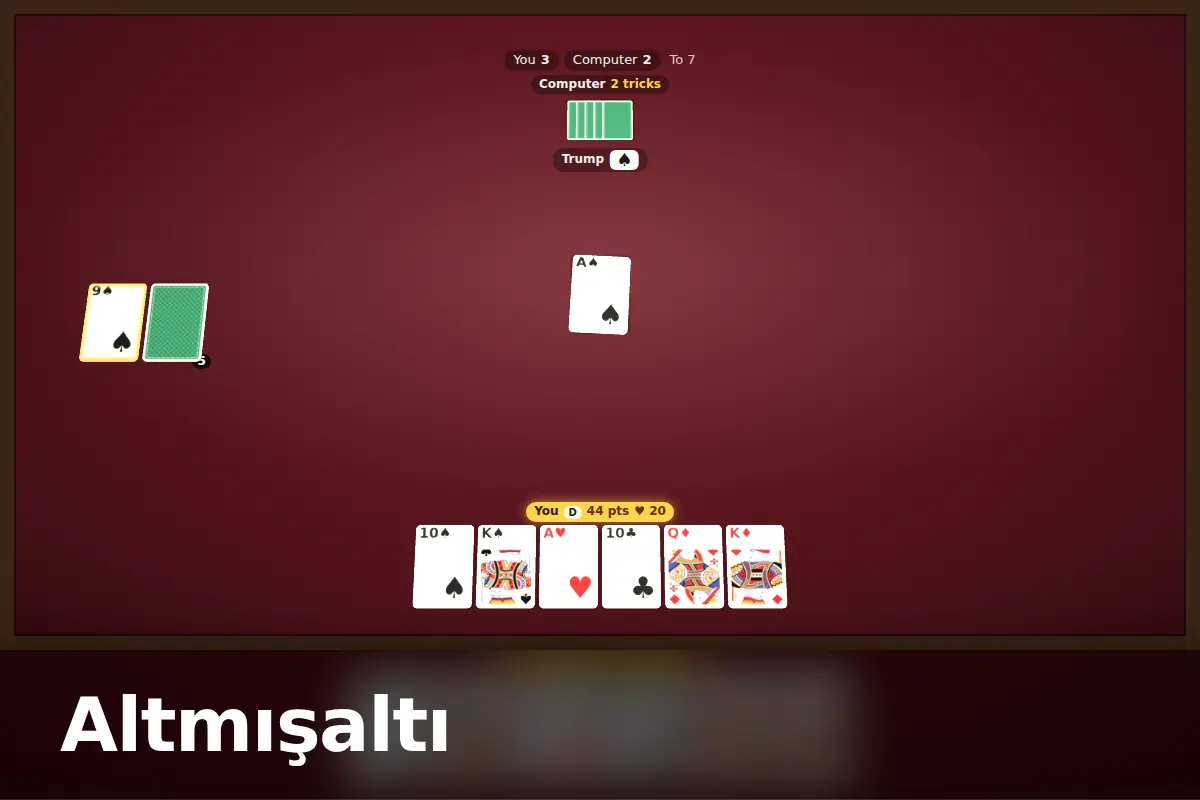
Batak is the trick-taking game you will find on almost every Turkish café table. This page is auction Batak (İhaleli Batak), the solo version where every player is on their own: each hand opens with an auction, the top bidder names trumps, and then all four of you fight for the 13 tricks. You sit at the bottom of the screen; the computer plays Right, Top and Left.
How to play
A standard 52-card deck is dealt out completely, 13 cards each, and aces rank highest. Turns pass to the right (counterclockwise), and the dealer marker (D) moves one seat along every hand.
The auction. Bidding starts with the player on the dealer’s right. On your turn the panel shows a row of Bid buttons and a Pass button. A bid is the number of tricks you promise to take on your own, and it must beat the current highest bid; the lowest opening bid is 4. Passing is final: once you pass you sit out the rest of that auction. As soon as three players have passed, the one still standing owns the contract. If the first three all pass without a bid, the dealer cannot pass and has to take the hand at 4 or higher.
Choosing trumps. The winner of the auction picks one of the four suits as trumps and leads to the first trick.
Playing. Each player adds one card to the trick. The highest card of the led suit takes it, unless a trump was played, in which case the highest trump wins. Whoever wins leads next. Batak is strict about which card you may play, and only the legal cards in your hand are lifted and clickable:
- If you hold the led suit, you must play it, and you must go over the best card of that suit already on the table if any of yours can. When someone has already trumped the trick, following suit is enough.
- If you are void in the led suit, you have to trump. If a trump is already down, you must beat it when you can.
- Holding neither the led suit nor a trump, you may discard anything.
- Trumps cannot be led until one has been played in an earlier trick. The only exception is a hand that has nothing left but trumps.
The “must go over” rule is what makes Batak feel different from most trick games. You often have to spend a queen to beat a jack even when an ace is still out, so high cards leave the game quickly.
Scoring
At the end of each hand a summary shows tricks, points and running totals for all four seats.
| Seat | Points for the hand |
|---|---|
| Contract holder who took at least the bid | one point per trick taken |
| Contract holder who fell short | minus the bid |
| The other three players | one point per trick taken |
So a player who bids 6 and takes 8 scores 8, but one who bids 6 and takes 5 scores −6. During play, the contract holder’s badge counts up against the target (“5 / 6”), so you can see how close they are.
A match is 10 hands by default; the Hands buttons at the top switch to 5. The highest total wins, and players tied on top share the win.
Strategy
Value your hand before you bid. The computer players estimate roughly this way, and it works: an ace is about one trick, a king with at least one card beside it is close to one, a queen in a three-card suit is about half. In your intended trump suit, every card past the third is worth almost a full trick, because once the others run out those small trumps win.
Bid what you can make, plus nothing. Going down costs the entire bid, so overbidding by one trick can turn +7 into −8. Because the three defenders also score their tricks, letting someone else take the contract cheaply is not a disaster; you still collect points while trying to set them.
Pick trumps by length. Five small trumps usually beat three big ones. Long trumps let you ruff the suits you are short in, and the follow-and-beat rule forces opponents to waste their honours early.
Pull trumps as the declarer. With four or more trumps, lead them from the top. Every round of trumps removes the cards that could ruff your side-suit aces.
Defend with your voids. As a defender, a missing suit is a weapon: the moment the declarer leads it, you are forced to trump, and that is often a trick they counted on.