How to play
This is the North American game: a 5 × 5 card with the letters B, I, N, G and O over its columns. Each letter owns fifteen numbers. B takes 1 to 15, I 16 to 30, N 31 to 45, G 46 to 60 and O 61 to 75, and every column shows five of them except N, whose middle square is a free space already stamped when the game starts. That leaves 24 numbers to cover.
Pick how many cards you want, from one to four, at 10 credits each, then press Play. Balls come out one by one, each tagged with its letter and coloured to match its column, so “G 52” tells you at a glance where to look. You don’t have to look, though: the game stamps every match for you. The big ball at the top is the latest call, with the last few beside it and a “Ball 12 of 75” style counter underneath.
The game pays two prizes:
- Line: five in a row on one card, across, down or corner to corner. A card has twelve such lines (five rows, five columns and two diagonals).
- Full house: every number on one card. That ends the game.
You share the hall with 36 computer-played cards. Pause and Resume stop and restart the caller, Faster speeds it up, and Draw all jumps to the result. Leave in the middle and you come back to a paused game on the same ball.
The free space and the twelve lines
The free square is what makes 75-ball feel the way it does. Four of the twelve lines run through the centre: the N column, the third row and both diagonals. Each of those needs only four called numbers instead of five, so a card’s early chances lean heavily on the middle cross. The corner-to-corner lines are the ones to watch in the first twenty balls.
In a few hundred simulated games with two player cards in a hall of 38, the line went on the 19th ball on average. The full house took much longer: about 66 balls on average, with most games finishing between the 56th and the 72nd. In other words, by the time somebody fills a card, nearly nine balls in ten have been called. A shared line happened in roughly one game in seven, and a shared full house in about one in four.
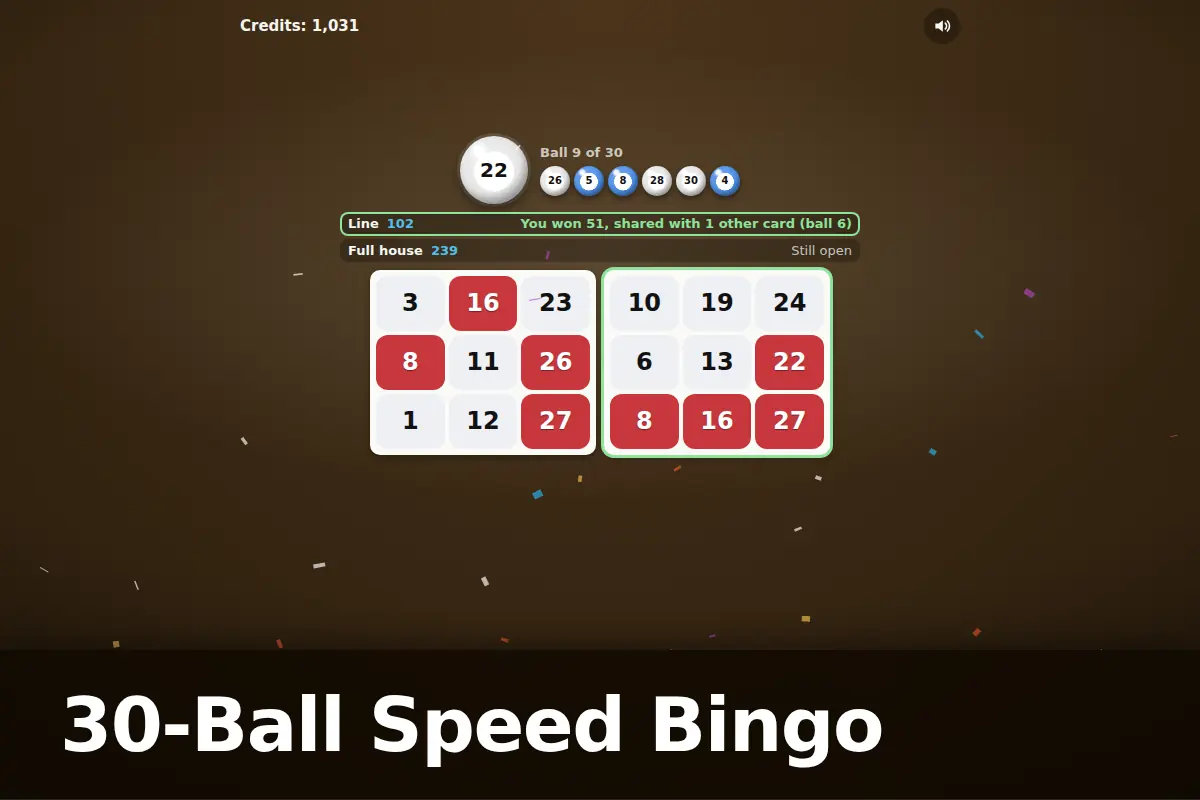
That’s a world away from 30-Ball Speed Bingo, where the whole game is over in about 21 balls on a nine-square card.
Prize pool
Each game’s pot is 90% of what all the cards cost together. With two of your cards and the hall’s 36 that’s 38 cards, 380 credits of sales and a 342-credit pot. The line takes 30% of the pot (102 credits for a lone winner) and the full house 70% (239). With four cards of your own the pot rises to 360, worth 108 and 252.
Ties split the prize evenly, rounded down to whole credits for you. While the game runs, each prize row shows its current value, or the ball it went on and who took it.
Strategy
Calls are random and marking is automatic, so no choice you make during a game changes who wins. What’s left to think about is how you spend.
- The per-card return is fixed. Every card in the hall, yours or the computer’s, is the same kind of random card, so each one gets back 90% of its price over many games, a little less once your shares are rounded down.
- More cards, more swings. Four cards give you four tickets in a 40-card hall instead of one in 37. You’ll collect prizes more often, and cost four times as much per game. Expected loss per card stays at about one credit.
- Speed is cosmetic. The ball order is shuffled when you press Play; Faster and Draw all only change how soon you see it.
- Past games tell you nothing. A number that hasn’t come up for a while isn’t due.
For a 75-ball game where the money goes to shapes like the X and the frame instead of straight lines, try Pattern Bingo.
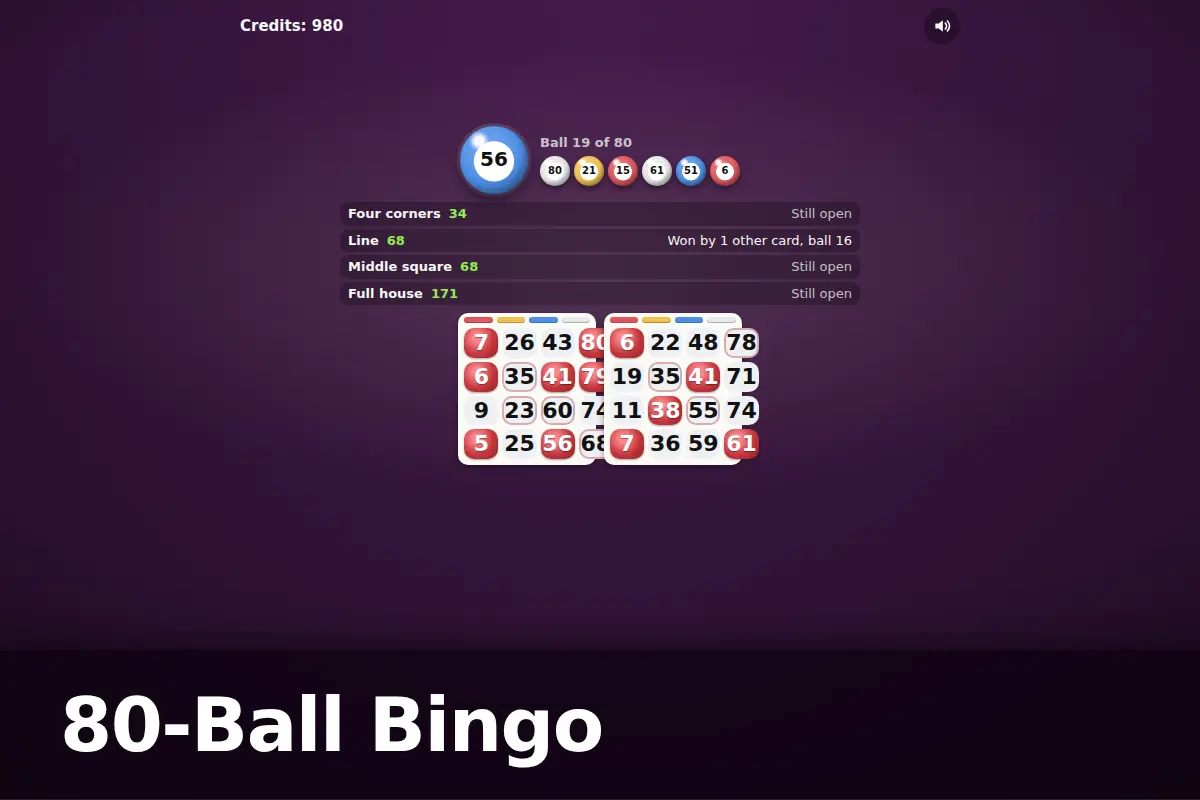
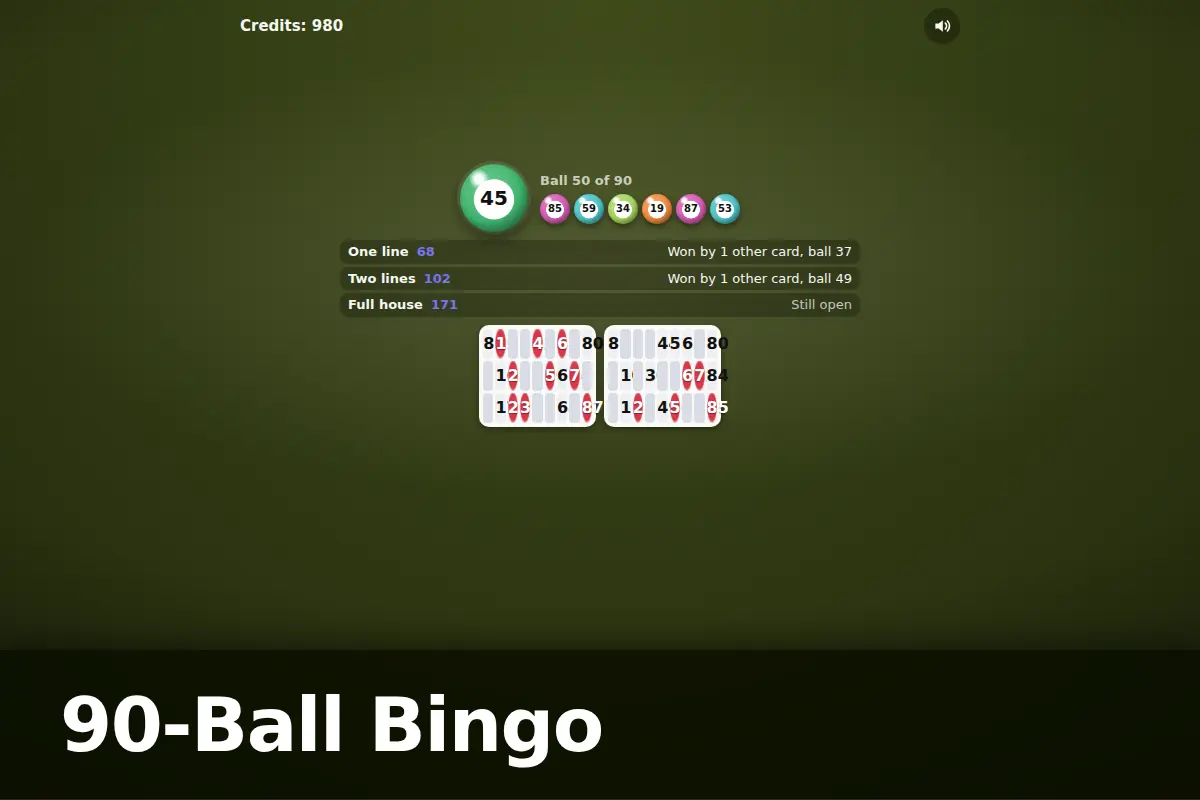
If you enjoy 75-Ball Bingo, try 80-Ball Bingo or 90-Ball Bingo next.