How to play
80-ball bingo plays on a square card of sixteen numbers, four across and four down, with no free space. The columns are colour-coded and each draws from its own block of twenty: red covers 1 to 20, yellow 21 to 40, blue 41 to 60 and white 61 to 80. The balls carry the same colours, so a yellow ball can only ever land in the second column.
Choose one to four cards (10 credits each) and press Play. The caller draws a ball about every 0.8 seconds and your cards are stamped automatically. Above them, a row of four prize labels shows what each prize is worth right now and, once it’s gone, on which ball and to whom. On your cards the four corner squares and the four centre squares are tinted, since they belong to pattern prizes.
Pause, Resume, Faster and Draw all set the pace. Thirty-six computer cards play in the same hall, and their price goes into the same pot as yours.
Four prizes, any order
Where most bingo halls pay a line and then a full house, this one pays four different shapes. Three of them can arrive in any order; only the full house always comes last, because it ends the game.
| Prize | What a card needs | Share of the pot |
|---|---|---|
| Four corners | the four corner numbers | 10% |
| Line | any row, column or diagonal (4 numbers) | 20% |
| Middle square | the 2 × 2 block in the centre | 20% |
| Full house | all 16 numbers | 50% |
Here’s the curious part. The four corners, the middle square and a line all need exactly four numbers. The difference is how many ways a card has to get there: the corners and the middle square are one fixed set each, while a line can be any of ten (four rows, four columns, two diagonals). So the line nearly always goes first. In a few hundred test games with two player cards among 38, the line fell around the 18th or 19th ball, and the corners and the middle square both took about 32 balls on average. The line was the first prize of the game more than four times in five.
The corners and the middle square are equally hard, yet the middle square pays twice as much. That doesn’t create a choice for you, since every card chases every prize at once; it just means the middle square is the bigger moment to watch for.
The full house came at about the 64th ball, between the 48th and the 73rd in our runs, and roughly one game in eight ended with two or more cards filling up on the same ball and sharing it.
What the prizes are worth
The pot is 90% of all card sales in that game. With two of your cards plus the hall’s 36, that’s 342 credits, which a lone winner would see as 34 for the corners, 68 for a line, 68 for the middle square and 171 for the full house. With four cards of your own the pot is 360 and the four prizes come to 36, 72, 72 and 180. Ties split a prize evenly, rounded down to whole credits on your side.
Strategy
There are no choices to make once the balls start rolling, so strategy here really means understanding what your credits buy.
Every card in the hall is generated the same way, which pins the long-run return at 90% of the card price for each card, yours or the computer’s. Rounding your shares down shaves a fraction more off. Four cards give you four chances at each of the four prizes and roughly four times the payouts over time, at four times the cost.
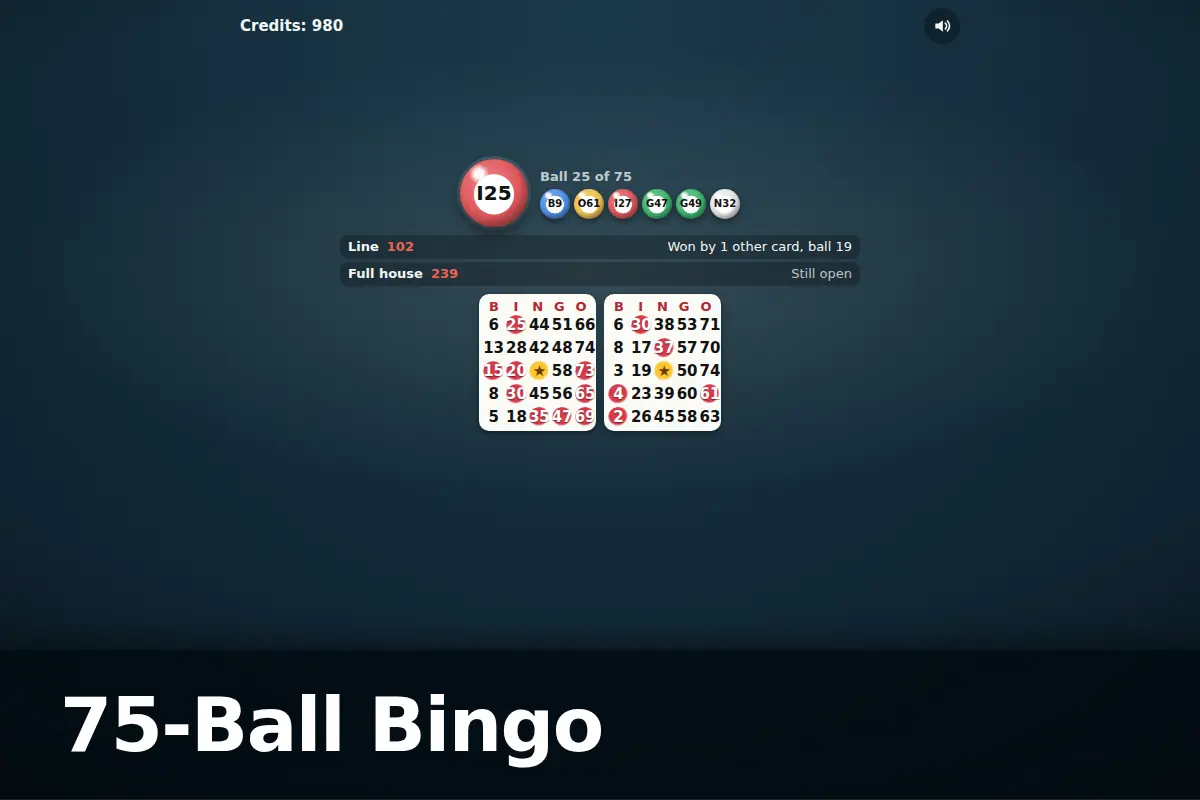
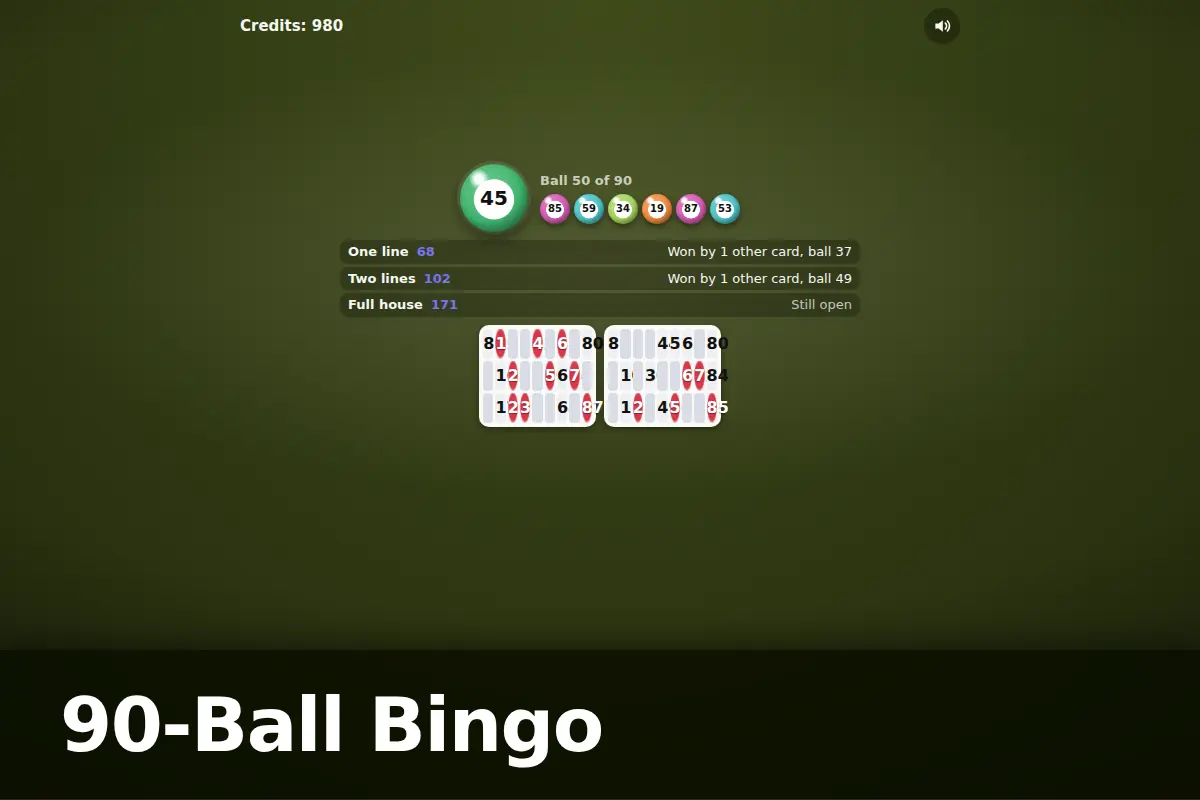
Because 80-ball spreads the pot over four prizes, results are smoother than in a two-prize game: a card that misses the full house can still pick up the corners or the middle square. If you’d rather have just two big moments per game, 75-Ball Bingo pays a line and a full house only. 90-Ball Bingo builds its prizes out of one, two and three rows instead of shapes.
If you enjoy 80-Ball Bingo, try 90-Ball Bingo or Blackjack next.