How to play
Bulls and Cows is a pencil-and-paper code-breaking game with numbers. In Turkey it is played as Sayı Bulmaca, which is where the plus and minus clues on this board come from.
The secret number has 3, 4 or 5 digits (pick with Digits). Every digit is different and the first digit is never 0. Your guesses follow the same rules, so the keypad greys out a digit you’ve already used in this entry, greys out 0 as a first digit, and won’t let you send the same number twice.
The clue after each guess is two counts:
- +n: n of your digits are in the secret number and in the same position.
- −n: n of your digits are in the secret but in a different position.
- 0: none of your digits appear anywhere.
Say the secret is 4096 and you guess 4567. The 4 sits in the right spot, the 6 is in the number but in the wrong spot, and 5 and 7 aren’t there at all, so the clue reads +1 −1. Notice that the clue never tells you which digits earned it; that’s the puzzle.
Type with the on-screen keypad or your keyboard, fix mistakes with Delete, and press Guess.
Solo and vs Computer
Solo is pure code-breaking. The computer hides a number and you try to find it in as few guesses as possible; the final screen tells you how many it took.
vs Computer is a race, and the screen splits into “Your guesses” and “Computer’s guesses”. First you set a secret number of your own for the computer to crack (or press Random number). Then you take turns, and you always guess first. If you crack its number, the computer still gets one more guess so you have both had the same number of tries: if it finds yours with that last guess, the game is a draw. If the computer cracks your number first, it wins. The computer’s number is revealed when the game ends.
Computer level only matters in this mode:
- Easy looks only at its last two clues until it has made ten guesses, so it often repeats ideas you can see are already ruled out.
- Medium always guesses a number that fits every clue it has received.
- Hard does the same, and once the possibilities shrink to a few hundred it picks the guess whose worst-case clue leaves the fewest numbers standing.
How big the search is
Because digits can’t repeat and the lead digit can’t be 0, the number of possible secrets is easy to count: 648 with three digits (9 × 9 × 8), 4,536 with four (× 7), and 27,216 with five (× 6). Every clue cuts that pile down.
Strategy
Spend the first guesses on coverage. With four digits, guesses like 1234 and 5678 between them test eight of the ten digits. Add up their clue totals (plus and minus together) and you know how many of the secret’s digits are 9 or 0 without guessing either.
Treat a 0 clue as a gift. Every digit in that guess is out, wherever it was placed. Mark them all at once.
Use the digit notes. The row of digits above the keypad is your scratch pad. Tap a digit once to cross it out (not in the number), a second time to mark it green (definitely in), and a third time to clear it. Notes are kept with your saved game.
Change one thing at a time. Once you know which digits are in, swap just two positions between guesses. If + goes up by two, both moved home; if it drops, they were right before.
Only guess numbers that could still be the answer. A guess that contradicts an earlier clue can never win, and in a race it wastes a turn the computer won’t waste.
Against Hard, open strong. Once it has narrowed things down the hard computer plays close to optimally, and cracking the code one turn after it is a loss, not a draw.
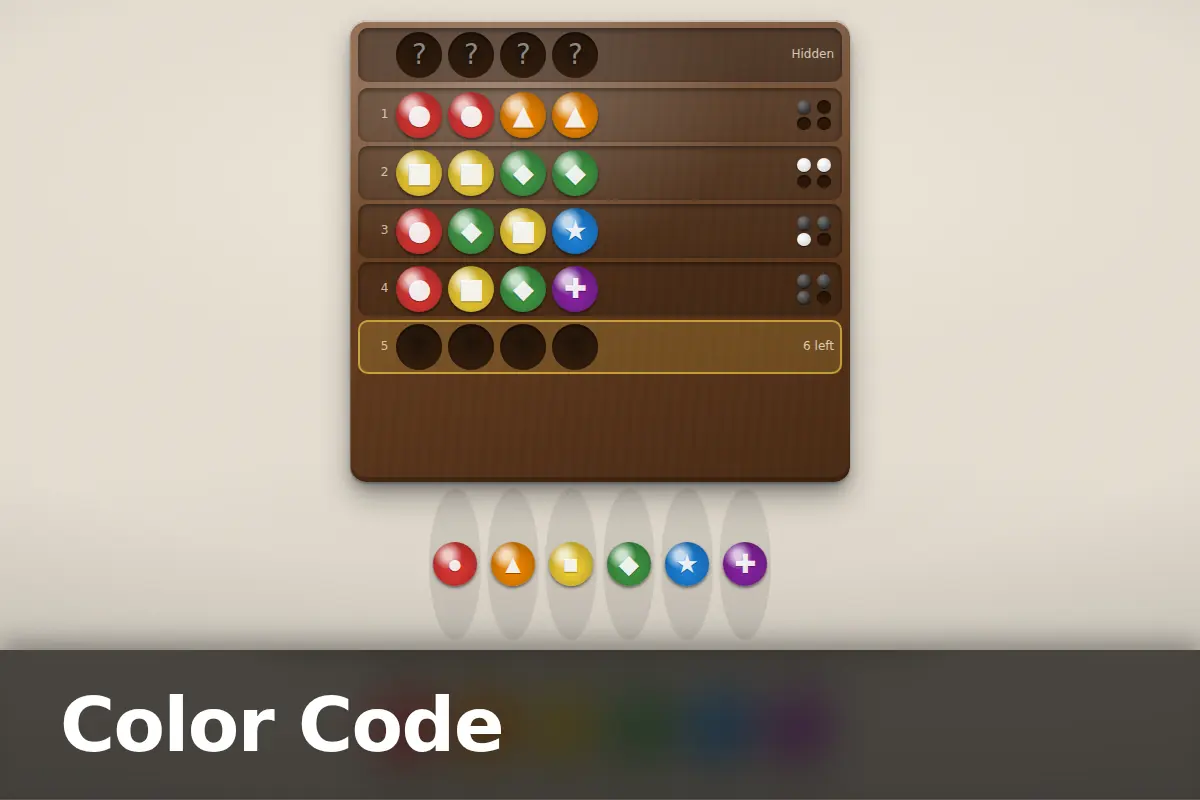
If you like this kind of deduction with colours instead of digits, try Color Code, which uses black and white pins for the same idea.
If you enjoy Bulls and Cows, try Color Code or Crate Push next.