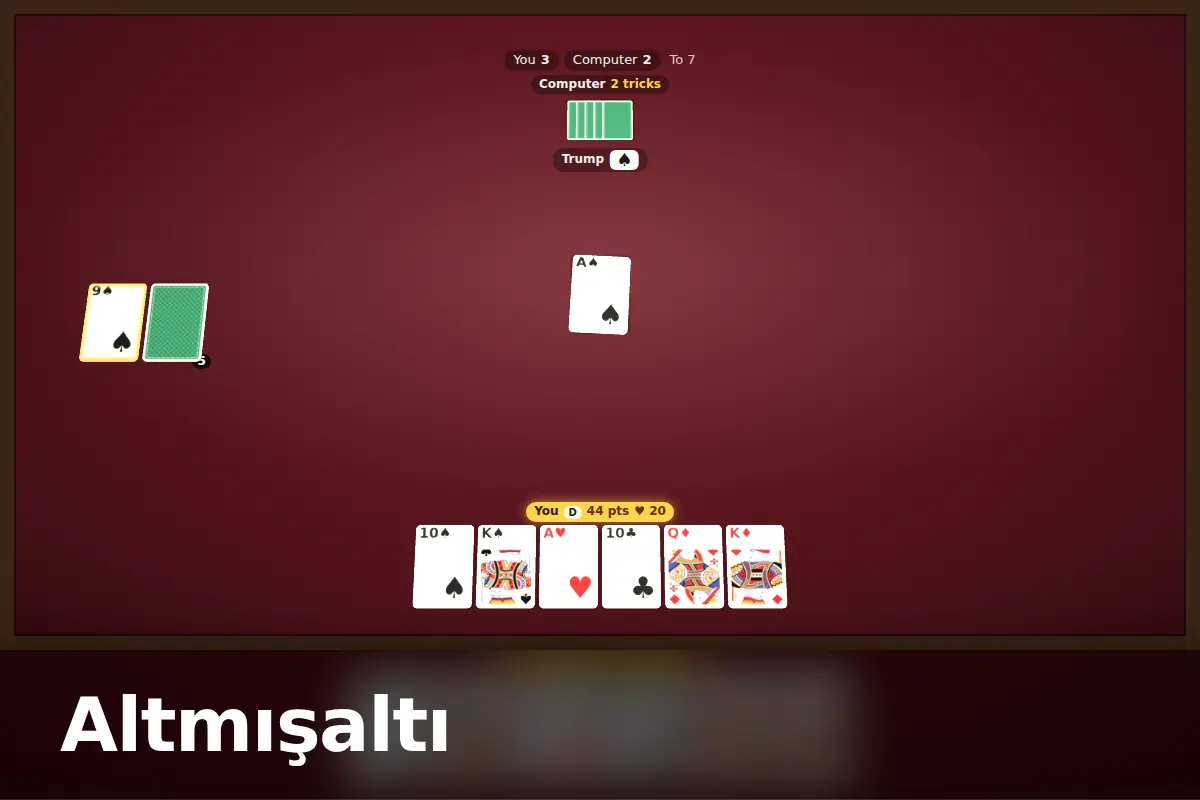
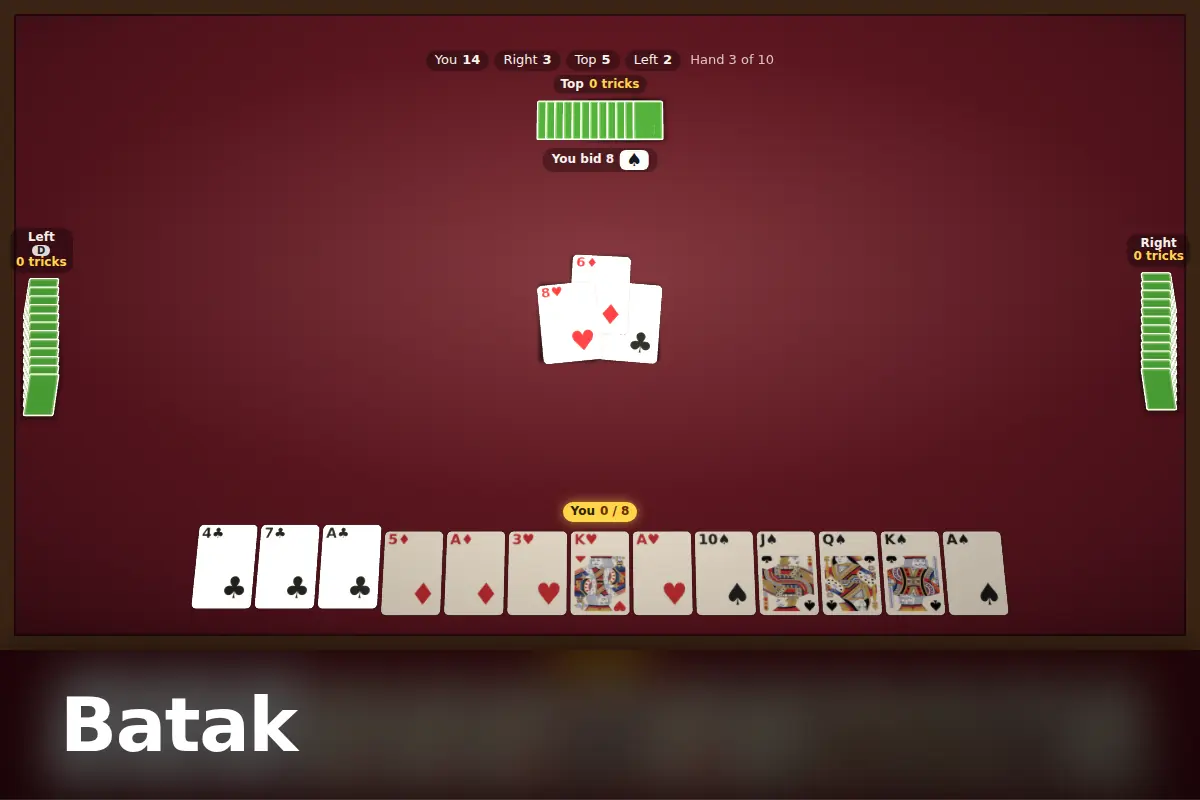
Partnership Batak, Eşli Batak in Turkish, keeps every card rule of Batak but changes who you are playing for. The player sitting opposite you at the top of the table is your partner; Right and Left form the other pair. All three other seats are computer players, so your partner is a bot too. The scoreboard tracks two columns, Us and Them, instead of four.
How to play
All 52 cards are dealt, 13 per player, with aces high. Play moves counterclockwise and the dealer (marked D) shifts one seat each hand.
Bidding for two. Starting on the dealer’s right, each player either bids or passes. A bid now means “our team will take this many tricks”, so the minimum is 7, more than half of the 13. Each new bid must top the last one. A pass takes you out of that auction for good. When three players have passed, the remaining bidder holds the contract. If the first three pass, the dealer must take it at 7 or more.
There is no signalling, no table talk and no seeing your partner’s cards. You only see your own hand; your partner’s hand shows as card backs like the opponents’. Everything you learn about your partner comes from their bids and their plays. Your partner can also outbid you: the auction does not treat partners differently, and a higher bid from across the table replaces yours.
Trumps and the lead. Whoever wins the auction chooses trumps and leads the first trick. That person decides the suit even though the contract is shared.
Card play. The rules on what you may play are exactly Batak’s. You follow suit and must beat the best card of that suit on the table if you can (unless the trick is already trumped); if void you must trump, overtaking any trump already down; with neither you discard; and trumps can’t be led until one has been played, unless you hold nothing else. Only legal cards are lifted in your hand.
One consequence surprises new players: the overtake rule ignores partnerships. If your partner leads the king and you hold the ace in that suit, you must play the ace on it. The game will not let you duck under your partner.
Scoring as a team
Tricks taken by either partner go into one pile. On the declarer’s seat, the badge shows the team’s progress against the bid, such as “6 / 8”, counting both partners’ tricks.
| Team | Points for the hand |
|---|---|
| Declaring team that reached the bid | one point per trick the team took |
| Declaring team that fell short | minus the bid |
| Defending team | one point per trick it took |
Because the minimum bid is 7, a failed contract always costs at least 7 points, while the defenders still bank their tricks. A side that bids 9 and takes 8 scores −9, and the defenders with 5 tricks get +5, a swing of 14.
A match lasts 10 hands, or 5 if you pick that under Hands at the top. The team with more points at the end wins; level totals are a shared win.
Strategy
Bid on two hands, not one. On average your partner holds a quarter of the high cards, and with them you can usually expect three or four tricks from that side. If you can count four solid tricks in your own hand with a good trump suit, 7 is a fair opening. The computer bots estimate their own hand only, so do not assume your partner bid with you in mind.
Read your partner’s bid. If your partner opened at 7 and then dropped out, they had a reasonable hand but not a great one. If they kept raising, they likely hold long trumps. When your partner wins the contract, lead the suits they did not choose as trumps and keep your own trumps to ruff.
Pull trumps from the declaring side. With four or more trumps, the declaring team wants them out quickly so their side-suit aces stand up. Either partner can do the pulling; it does not have to be the declarer.
Defend as a pair. On defence, your goal is simply to take enough tricks to break the bid. With a bid of 8, five defensive tricks set it. Keep count, and once the contract is beaten, every extra trick is still a point for your team.
Mind the forced overtakes. Since you must beat the table when you can, avoid leading a suit where your partner holds a lone honour; you may force them to spend it under your card. Leading from length is safer.
If you enjoy Partnership Batak, try Partnership Koz Maça or Partnership Pishti next.