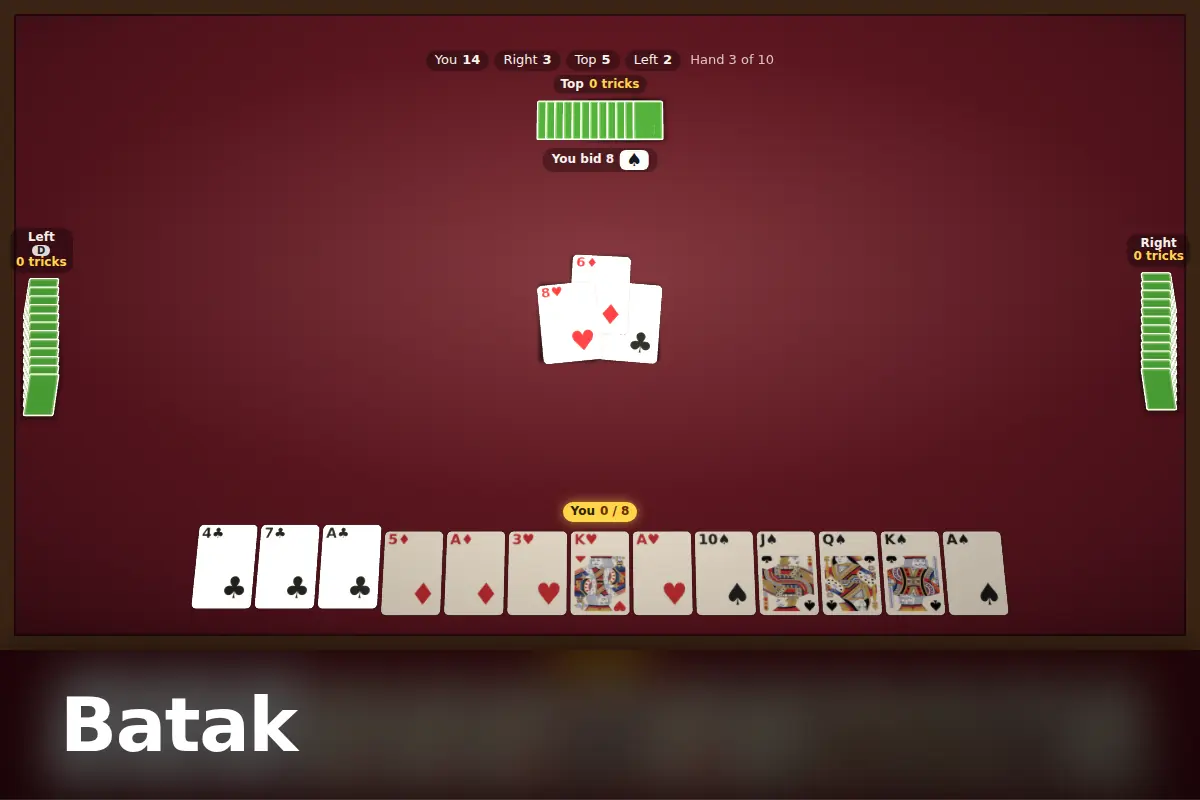
Spades is the partnership trick-taking game where spades are always trumps. You sit at the bottom, your partner across the table, and two computer opponents on the sides. Each hand your team bids a number of tricks and then tries to take at least that many, while the bags from taking too many slowly add up against you.
How to play
The deal. Four players, 52 cards, 13 each. The deal moves to the right (counterclockwise on screen) every hand, and the player to the dealer’s right bids first and leads the first trick.
Bidding. Each player in turn says how many tricks they expect to take, from 0 to 13. A bid of 0 is nil: you promise to take no tricks at all. Your team’s contract is the sum of your two bids, not counting nil. Bids cannot be changed once made.
Play. The leader plays any card except a spade, unless a spade has already been played this hand (spades are “broken”) or spades are all they have. Everyone else must follow suit when they can; otherwise any card goes, including a spade. The highest spade wins the trick, or the highest card of the suit led if no spade was played. The winner leads next.
Scoring. If your team takes at least its contract, you score 10 points per bid trick plus 1 point for each extra trick, called a bag. Fall short and you lose 10 points per bid trick. Bags accumulate across hands: every time a team collects 10 of them it loses 100 points. A player who bid nil scores +100 for taking no tricks and −100 for taking any; the tricks they take still count for the team’s total.
Winning. Choose Play to 250 or 500 at the top. After any hand in which a team has reached the target, the higher total wins; a tie plays on. A match is capped at 40 hands, after which the higher total wins and an exact tie is shared. On a phone, tap the highlighted cards in your hand; bid with the row of buttons when it is your turn.
Strategy
Count your sure tricks. The ace and king of spades are near-certain tricks; so is the queen with three or more spades. Side-suit aces win when the suit is led early. Add half a trick for each spade beyond the third and bid the total.
Short suits are worth spades. A singleton or void in a side suit lets you ruff with small spades, which turns long spades into extra tricks.
Respect the bags. Once your contract is safe, stop winning tricks: throw low cards and let the opponents collect the bags. Ten bags cost more than most hands earn.
Protect a nil. If your partner bid nil, play high early to take tricks over them and lead suits they are short in. If you bid nil yourself, dump your dangerous high cards as soon as you cannot follow suit.
If you enjoy Spades, try Speed or Spider Solitaire next.