How to play
Çanak means “bowl”, and that bowl is the only thing separating this game from plain Okey. Tiles, the deal, sets and turns are unchanged. What changes is the money flow: every round everyone feeds a shared pot, and one specific kind of finish empties it.
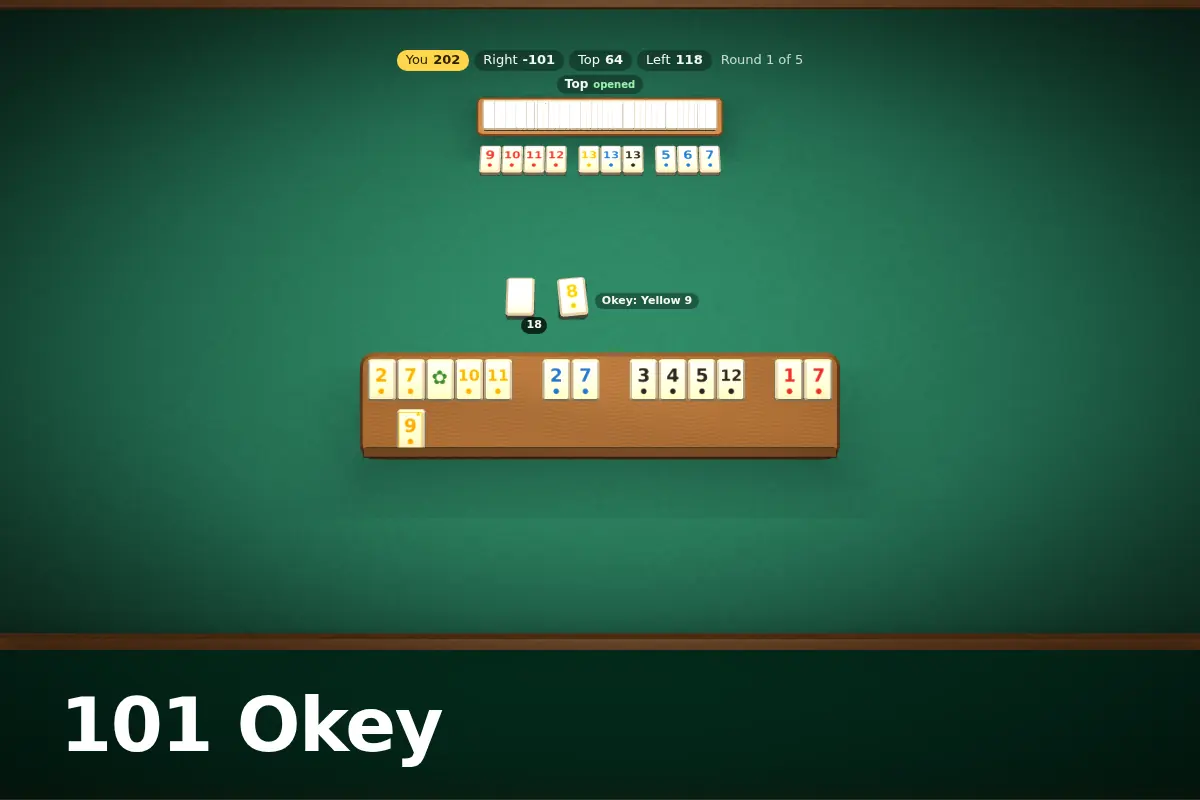
Quick recap: you sit at the bottom with three computer opponents, play moving counterclockwise. Each round a face-up indicator decides the okey: the next number up in the indicator’s colour (a 13 indicator makes the 1 wild). Both okey tiles are wild and wear a gold star; the two false jokers just stand in for the okey’s own value.
The dealer starts with 15 tiles and opens by discarding. The others hold 14; a turn is one tile taken (middle pile or left neighbour’s discard) and one thrown to the right. Your rack takes drags or tap-and-place moves, and Sort runs and Sort pairs tidy it for you.
To finish, lay out 14 tiles as runs (one colour, three or more numbers in a row, 12-13-1 allowed but not 13-1-2) and groups (one number in three or four colours), or as seven identical pairs, and throw the 15th tile with Finish. The tile that would let you finish glows green.
The pot
The gold Pot counter in the score bar tracks the çanak. Here is exactly how this version runs it:
- Ante. At the start of every round, including the very first, each of the four players moves 1 point from their score into the pot. The match begins at 20 points each, so you actually open on 19 with 4 in the pot.
- Cracking it. Only a player who finishes by throwing an okey as the last tile takes the pot, all of it, on top of the normal scoring. A finish with ordinary sets or seven pairs pays the usual penalty but leaves the pot where it is.
- Showing the indicator. Holding the twin of the indicator on your first turn lets you press Show indicator. The other three lose 1 point each, and you also lift half the pot, rounded down. With 7 in the bowl you’d take 3 and leave 4.
- Rolling over. If nobody cracks it, the pot stays for the next round and grows by another 4. Draw rounds, where the middle pile runs dry, roll it over too.
- The end. The match stops when anyone hits 0. Because the ante comes out before a round is dealt, paying in can be what knocks someone out. Anything still in the bowl at that point belongs to nobody.
Scoring
The standard penalties still apply to everyone except the finisher:
| Finish | Others lose | Pot |
|---|---|---|
| Plain sets | 2 | stays |
| Seven pairs | 4 | stays |
| Sets, okey thrown last | 4 | finisher takes it |
| Seven pairs, okey thrown last | 8 | finisher takes it |
Example: three rounds pass with no okey finish and no show, so the fourth round opens with 16 in the pot. You finish with sets and throw your okey last. Each opponent drops 4, and you add 16. That one round is a 20-point swing against each rival.
Turkish tables run the çanak many different ways; this page describes the version the game plays.
Strategy
Let the pot size set your patience. Early, when the bowl holds 4 or 8, a normal finish is fine: take the round and stop the bleeding. Once it reaches the high teens, a hand that can finish now with an ordinary tile but would finish with the okey in a turn or two deserves a second look. Waiting is a gamble: anyone can end the round first.
An okey is worth more here than anywhere else. In plain Okey it is a flexible tile with a bonus attached. In Çanak it is the only key to the pot, so build your hand so the okey is the spare tile rather than one that’s holding a set together.
Showing is now worth more than 1 point. The indicator twin pays half the pot, so a show on a big rollover can be bigger than an ordinary finish. Never skip it; the button disappears once your first turn is over.
The ante shortens matches. Every round costs a point, so when you’re low, a quick finish beats chasing the pot.
The bots ignore the pot. They finish as soon as they can and throw an okey last when they have the choice, but they won’t hold back for a bigger bowl. A large pot is a target that mostly you are aiming at.
The team version, without a pot, is Partnership Okey.