How to play
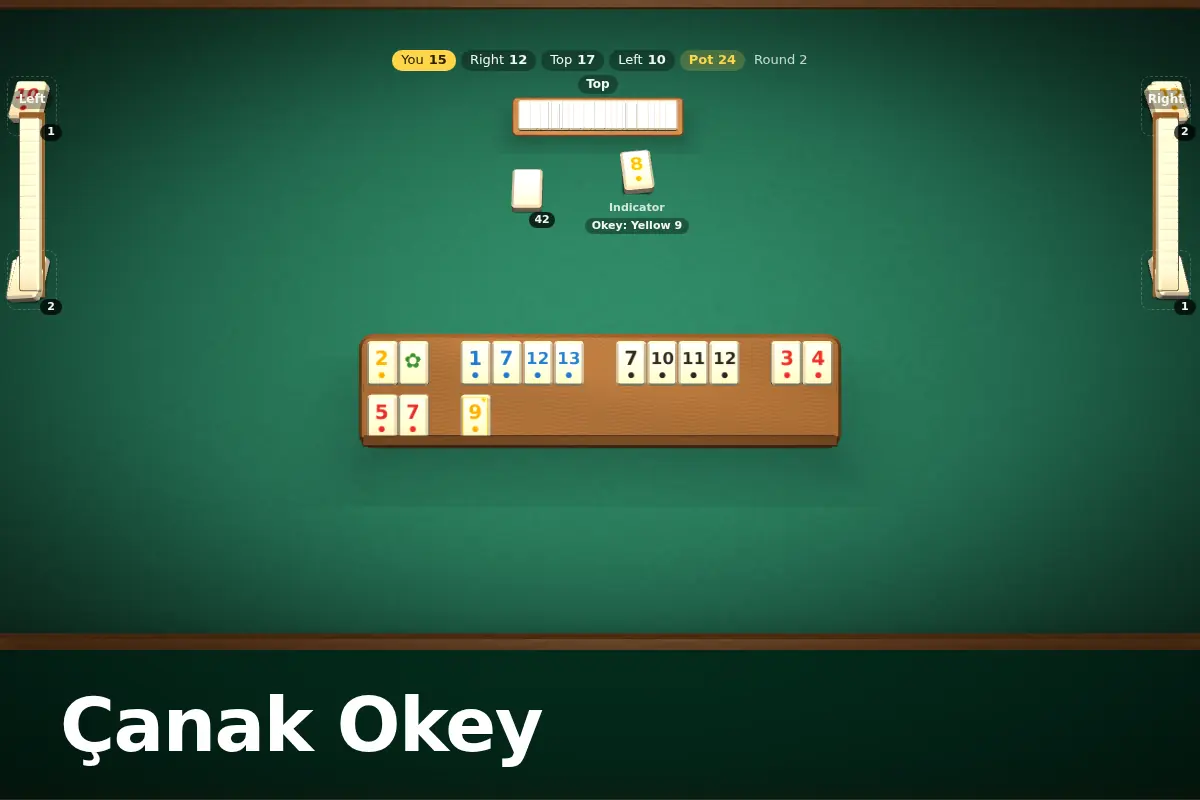
In Eşli Okey the four players form two fixed teams. Your partner sits across from you at the top of the screen, labelled Partner; the seats on your left and right belong to the opposing pair. All three other seats are computer players, and turns go counterclockwise, which means the order around the table is always you, an opponent, your partner, the other opponent.
Everything about the tiles works as in solo Okey, so here is just the short version:
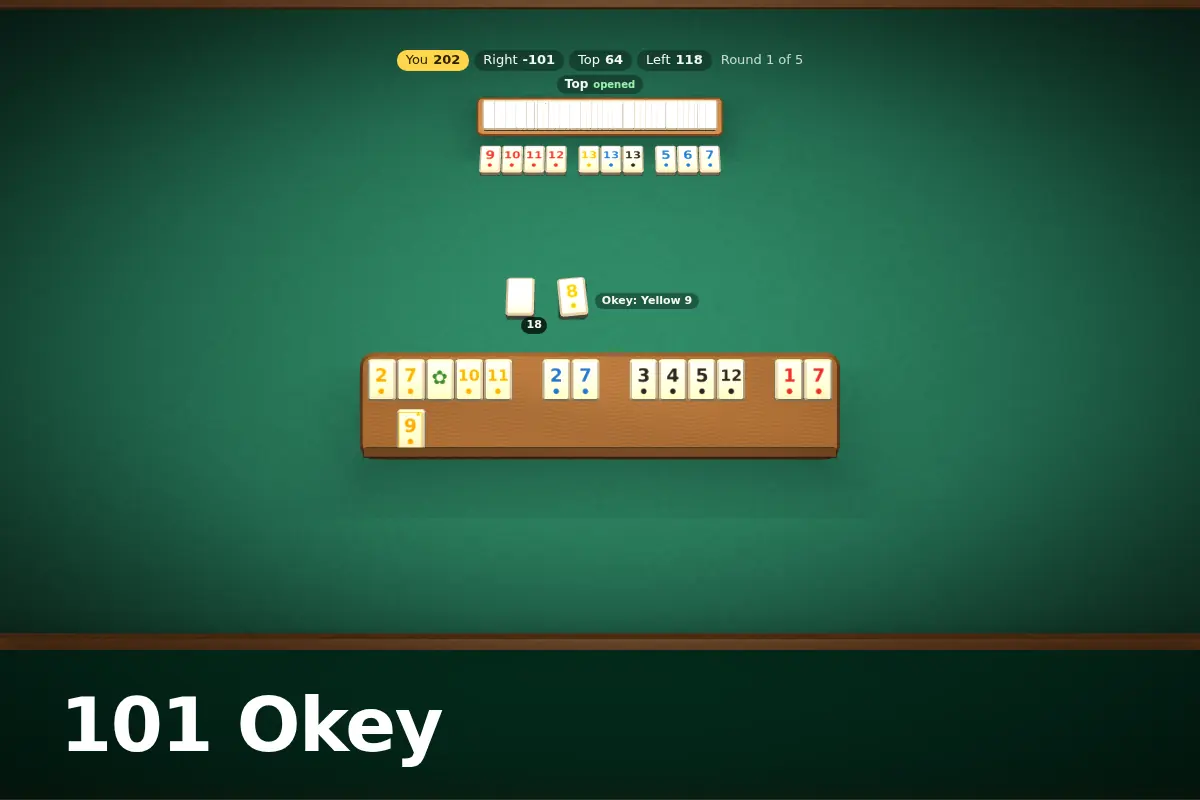
- 106 tiles: 1 to 13 in four colours, each twice, and two false jokers.
- A face-up indicator names the okey (one higher, same colour, with 1 following 13). The two okeys are wild; a false joker is not and plays as the okey’s own value.
- Dealer gets 15 tiles and discards first; everyone else has 14.
- On a turn you take one tile, from the middle or from the discard of the player on your left, and then throw one to your right.
- You win the round by arranging 14 tiles into runs and groups (or seven pairs) and pressing Finish with the 15th.
Use Sort runs and Sort pairs to organise the rack, or arrange it by hand with drag and drop.
How the teams score
Both teams start on 20 points per player. The scoring table is the familiar one, but the penalty only ever lands on the two opponents of whoever finished. The finisher’s partner loses nothing.
| Your side finishes with | Each rival loses |
|---|---|
| Runs and groups | 2 |
| An okey as the last tile | 4 |
| Seven pairs | 4 |
| Seven pairs, okey last | 8 |
It works the other way too: when either opponent finishes, you and your partner each drop by the same amount. The same rule covers the indicator. If anyone shows the twin of the indicator on their first turn with Show indicator, the two players on the other side lose 1 point each.
The result is that partners’ scores are always identical, and so are the two rivals’. The score bar effectively shows two numbers. A drained middle pile ends the round with no penalty, and when one team’s score reaches 0 the match is over and the two players of the other team win together.
Seating and the flow of tiles
This is where the team game feels different. Because seats alternate between teams, every tile you can pick up comes from an opponent and every tile you discard goes to an opponent. Your partner draws from the right-hand rival and passes to the left-hand one. You can never hand a tile directly to your partner, and they can’t hand one to you.
So cooperation is indirect. What you can do:
- Starve the opponent on your right. They are the only player who sees your discards first. Throwing them tiles that fit their sets helps the other team twice over, since their finish costs both you and your partner.
- Read what your partner throws. Their discards land on the left-hand opponent’s side, so you can’t use them, but they show what your partner is not collecting.
- Track the left-hand opponent. Their pickups from your partner’s pile reveal what they need, and they are the player whose discards you get to choose from.
Strategy
A partner finish is your finish. The points work out the same whether you go out or your teammate does. If your hand is hopeless this round, your job shifts to defence: keep the right-hand opponent from building, and let your partner race.
Speed beats size more than in solo play. With four people chasing two goals rather than four, rounds tend to be decided by whichever team gets there first. A plain 2-point finish now is usually better than waiting for the okey to double it.
Keep okeys, still. A wild tile is the fastest route to a finish, and throwing it last doubles the penalty on both rivals.
Don’t count on signals. The computer partner plays its own hand as well as it can and does not signal or try to feed you. Treat it as a strong, silent teammate.
Watch the 20-point clock. A seven-pairs finish with the okey thrown last costs each rival 8, so two of those nearly end a match. If the other team is low, a big finish closes it out.
If you enjoy Partnership Okey, try Partnership 101 Okey or Pig next.