How to play
101 Okey takes the tiles of Okey and turns them into a laying-down game. Instead of hiding a finished hand on your rack, you put sets face up on the table, everyone can build on them, and the score is a running count of penalty points where lower is better.
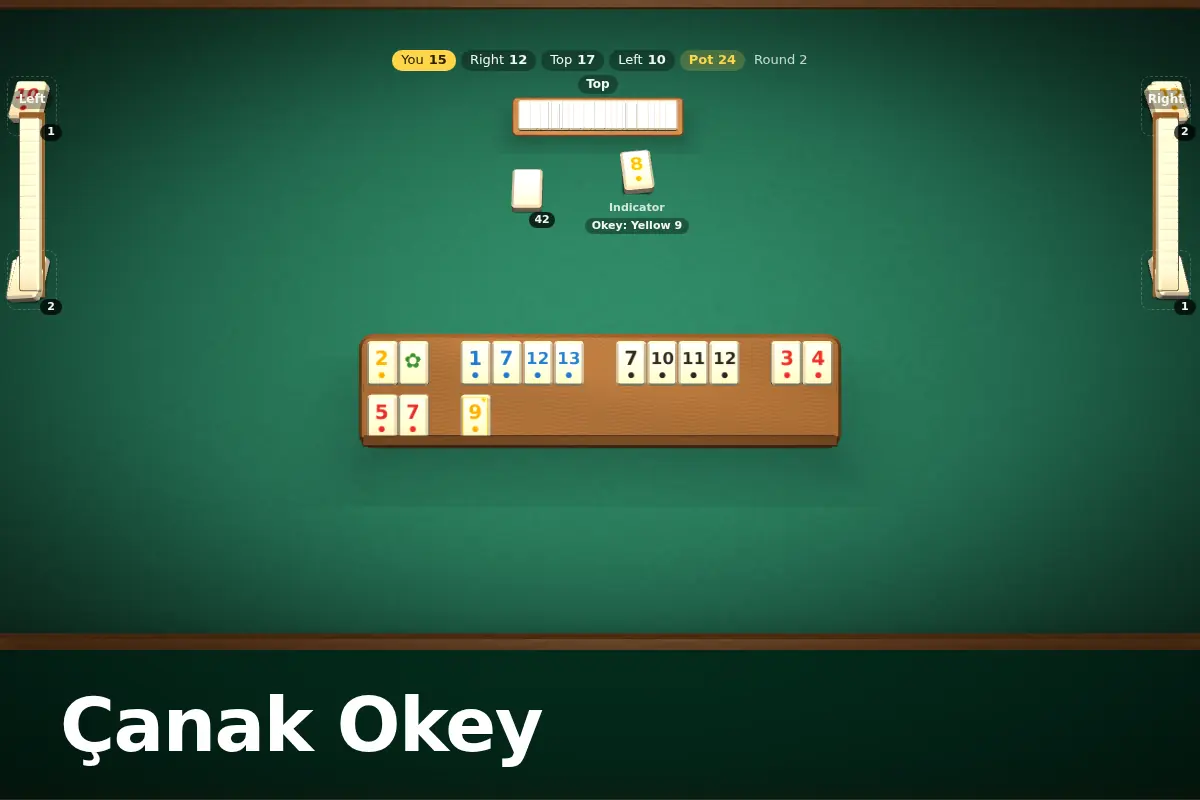
You sit at the bottom against three computer players; turns pass counterclockwise. The set of 106 tiles is the usual one, and a face-up indicator again names the okey (same colour, one number higher). Both okeys are wild. The two false jokers stand for the okey’s colour and number.
Bigger hands. The dealer receives 22 tiles and everyone else 21. The dealer begins by throwing one tile away.
Each turn:
- Take a tile. Normally from the middle pile. The left player’s last discard is only available if you can put it on the table this very turn, either as part of your opening or, once you’ve opened, in a new set or on an existing one. If you take it, it has to go down before you may discard.
- Play to the table, if you are able (see opening below).
- Discard one tile to your right.
Sets. A run is three or more numbers in a row in one colour. Unlike plain Okey, the 1 only works as the low end: 1-2-3 is fine, but 12-13-1 is not. A group is one number in three or four different colours. If a three-tile set could count either way, for example a tile and two okeys, it scores as whichever is worth more.
The 101 opening
Nothing goes on the table until you open, and opening has a threshold. Pick sets from your hand whose tile numbers add up to at least 101. An okey counts as the tile it replaces. Example: yellow 10-11-12-13 (46) plus a group of three 13s (39) is 85, still short; add red 5-6-7 (18) and you have 103 and can open.
The alternative is five pairs, each two identical tiles (an okey pairs with anything).
On screen: select the tiles of one set, tap Set aside, and repeat. A counter shows your running total against 101. When it is high enough, the Open button lights up with the number; with pairs it reads Open with N pairs. Take back returns set-aside tiles to your rack. You must keep at least one tile in hand to discard.
You can’t add more on the turn you open. From your next turn, use Lay set for new sets (pairs only, if you opened with pairs) and add single tiles to any run or group on the table, including other players’ sets: select the tile and tap the set. The round ends when someone throws their last tile.
Penalty scoring
| At the end of the round | Penalty |
|---|---|
| The player who went out | -101 |
| Went out with an okey as the last tile | -202 |
| Never opened | +202 |
| Opened with sets | sum of tile numbers still in hand |
| Opened with pairs | double that sum |
Okeys and false jokers left in hand count as the okey’s number. If the middle pile runs dry, nobody gets the -101, but everyone else is still scored. Pick 3, 5 or 9 rounds with the Rounds buttons; the setting applies to the next match. Lowest total after the last round wins.
Strategy
The +202 is the real danger. One round stuck unopened costs more than most opened hands ever will. Build towards 101 first and worry about going out later.
High tiles open fast, then hurt. Runs and groups of 11s, 12s and 13s get you to 101 quickly. Once you’re open the same tiles become the heaviest penalty if they stay in hand, so play them out onto the table early.
Use the board. After opening, almost any tile that extends a run or fills a group is a free way to shed points. Check the table each turn before you discard.
Pairs are a gamble. Five pairs is often reachable before 101, but every point left in your hand then counts twice, and you can only lay pairs afterwards.
The left discard is a signal. You may only take it if you’ll use it immediately, so when an opponent takes yours, they’re close to opening or already building.
Playing as a team changes the maths; see Partnership 101 Okey.
If you enjoy 101 Okey, try Partnership Okey or Partnership 101 Okey next.