How to play
This table uses a double-six set: 28 tiles, every pairing of the numbers 0 (blank) through 6 exactly once. You sit at the bottom of the screen; the computer fills the other seats. Pick Players (2, 3 or 4) and Game (Draw game or Block game) from the buttons above the table.
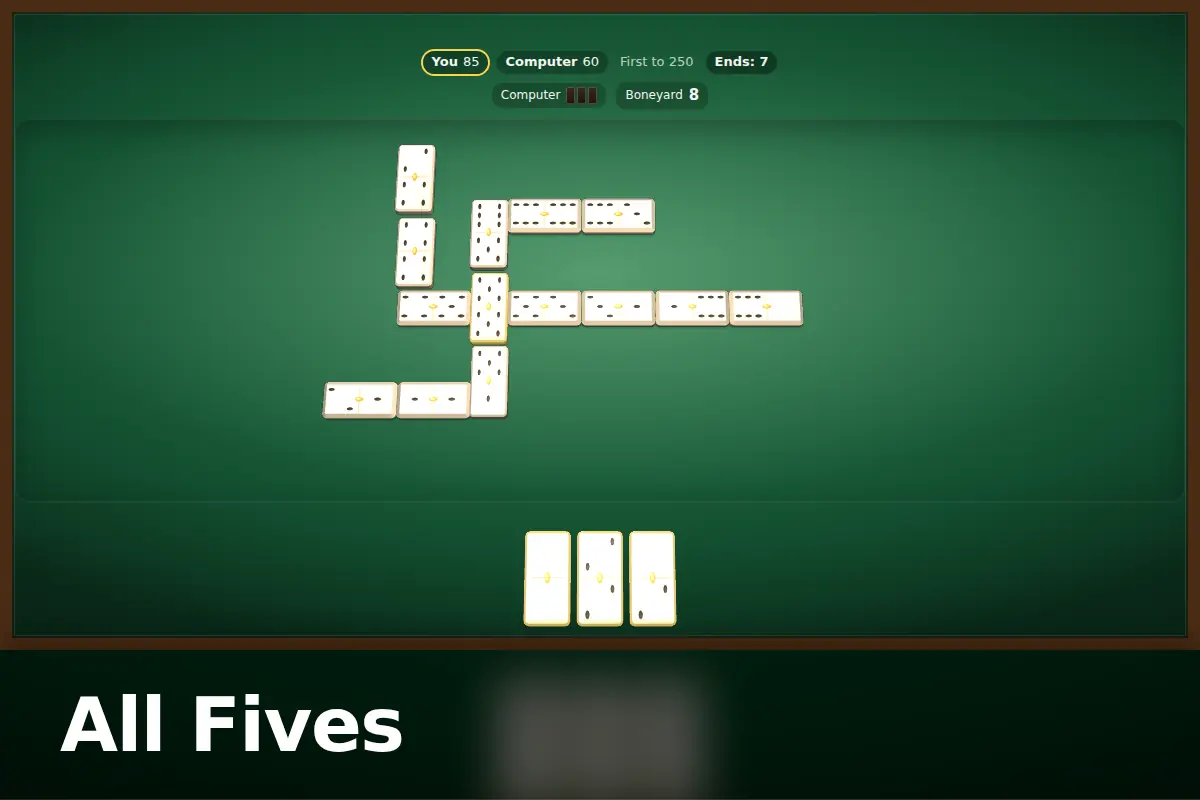
When it’s your turn, the tiles that fit glow. Tap one and it goes onto the line. If a tile matches both open ends, the game asks you to tap the end you want, and both ends are marked with the number they currently show.
Opening a match. In the very first hand the computer looks at every rack and finds the highest double. Whoever holds it must lead with that tile,. If nobody was dealt a double at all, the tile with the most pips leads instead. From the second hand on, the winner of the previous hand leads with any tile they like.
Following. Play passes clockwise. A tile can join the line only where its number matches the open end it touches. The line grows in two arms from the first tile, and the board lays both arms out to fit the table.
Draw game and Block game
In the Draw game two players get 7 tiles each and three or four players get 5 each. Everything left over goes face down into the Boneyard, whose count is shown on the table. If nothing in your rack fits, press Draw to take one tile. You keep drawing, one at a time, until something fits; then you must play it. Only when the boneyard is empty does the Pass button appear.
In the Block game everyone gets 7 tiles and there is no boneyard. With four players all 28 tiles are dealt, so every number is somewhere in someone’s hand. With two or three players, 14 or 7 tiles are left out of play face down, and nobody will ever see them that hand. If you can’t match an end, you press Pass and that’s it.
The practical effect: Draw hands usually end with somebody playing out, while Block hands lock up far more often, especially with two players and a big unseen pile.
Scoring
A hand ends in one of two ways.
- Domino. The first player to lay their last tile wins the hand and scores the total pips still sitting in all the other racks.
- Blocked. If every player passes in a row, the line is dead. The racks are counted; whoever holds the fewest pips wins and scores the pips of everyone else. If two or more players tie for the lowest count, nobody scores that hand.
At the end of each hand the table reveals every rack with its Pips left and the running Score. Press Next hand to reshuffle. The first player to reach 100 points takes the match; a blocked hand with a tie keeps the same leader for the next deal.
Strategy
The whole set holds 168 pips, and any single number appears on seven tiles. Those two facts drive most decisions.
Shed weight when it’s cheap. If you have a choice between the 6-5 and the 2-1 and both keep you flexible, play the 6-5. Being caught with heavy tiles when an opponent dominoes hands them points, and in a blocked hand a low count is what wins.
Don’t sit on doubles. A double only ever matches one number. Get the 4-4 down while fours are still open, because once the other six fours are gone it is dead weight.
Count suits. Watch how many tiles of a number have been played. If five of the seven threes are on the table and you hold the sixth, only one more is left anywhere. Closing an end on that number can block a player who needs it.
Read draws and passes. When an opponent draws or passes, they hold nothing matching either open end. Leave those numbers showing.
In Block, play for the count. With no boneyard to bail you out, a blocked finish is likely. Once you sense the line is closing, play your highest tile that fits, not the one that keeps your options widest.
For a tile game with more hidden information, try the rummy-style Okey.
If you enjoy Dominoes, try Dots and Boxes or Farkle next.