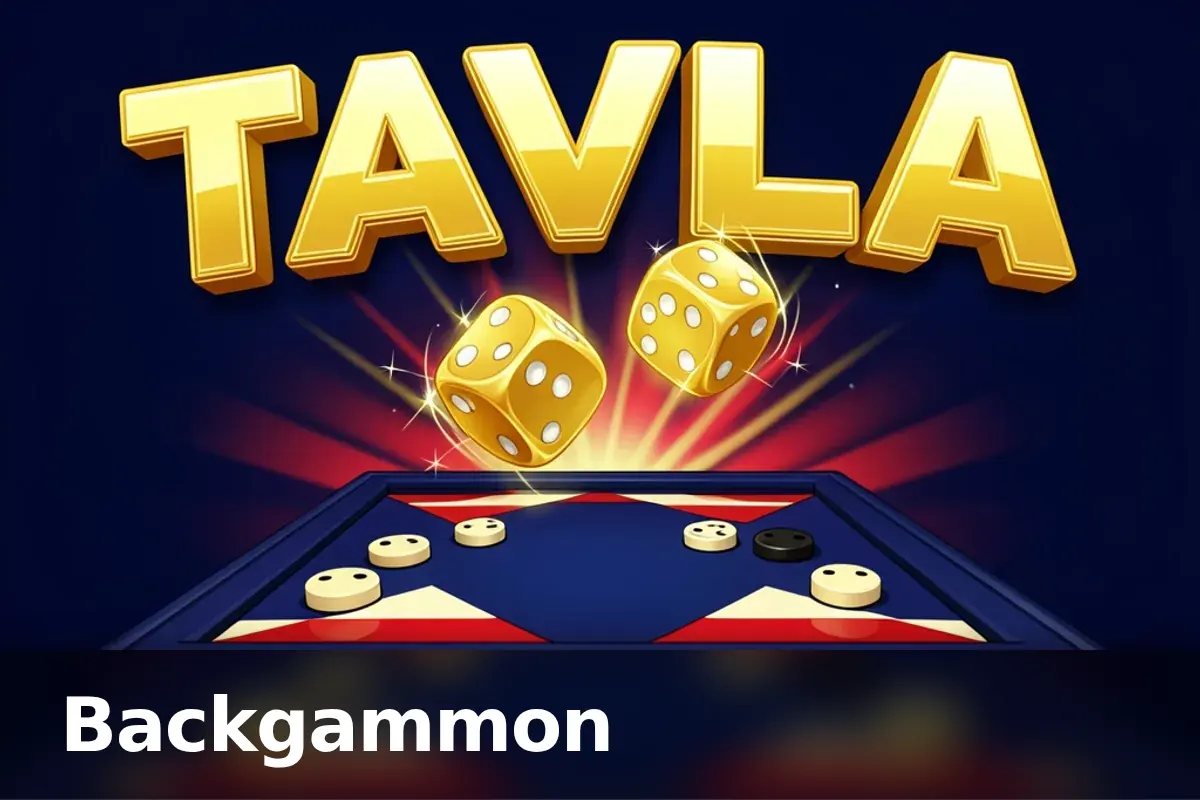
Gülbahar is one of the three games Turkish players traditionally run through on a tavla board, alongside ordinary backgammon and Mahbusa. Outside Turkey the same game is usually called fevga. It looks like backgammon at first glance: 15 checkers each, two dice, bear off to win. Then the opening move shows how different it is. Both armies start stacked on a single point, both travel round the board in the same direction, and since nothing can be hit, the whole game is about occupying points before your opponent can use them.
How to play
You play white against the computer, which plays black.
Starting position. All 15 of your checkers sit on one point in the top right corner. All 15 of the computer’s sit diagonally opposite, in the bottom left. Each side’s starting point is the other side’s halfway mark.
Direction. Both of you move counterclockwise. Your checkers travel left along the top row, cross over, and run right along the bottom row into your home quarter at the bottom right. Black does the mirror image: right along the bottom, left along the top, home at the top left. Every checker has 24 points to travel, so each side begins with a pip count of 360. The info line under the board keeps both pip counts up to date.
Opening. Each side rolls one die; the higher number moves first, using those two dice. Ties are rerolled.
A turn. Press Roll dice, then tap one of your checkers and tap a highlighted destination. Each die is a separate move, and doubles are played four times. If you can use both dice you must; if only one can be played, it has to be the larger one when that is possible. Undo takes back the steps of the current turn, Hint marks a suggested move, and Done ends your turn.
The rules that make Gülbahar its own game:
- One checker owns a point. You can never land where the opponent has a checker, even a single one. There is no hitting and no bar.
- One runner first. Until your first checker has gone past the opponent’s starting point, no second checker may leave your own start. The opening turns are spent racing that runner around the first half of the board.
- No six-point prime in front of a trapped opponent. You may not hold six points in a row if any of the opponent’s checkers are still behind that row. Five in a row is allowed. Once all their checkers have passed it, six or more is fine.
- Bearing off. With all 15 checkers in your home quarter you bear them off, exactly as in backgammon: a die equal to a checker’s distance takes it off, and a higher die can remove your farthest-back checker.
Scoring
The first player to bear off every checker wins the game. A plain win counts 1 point. If the loser has not borne off a single checker yet, it is a double win (mars) worth 2 points; there is no triple. The running tally, “You · Computer”, sits above the board and survives between games. Choose Easy, Medium or Hard for the computer at the top of the screen.
Strategy
Get the runner moving. Until your first checker passes black’s start, fourteen of your checkers are frozen. Use big numbers on the runner early so the rest of your army can come out.
Build points in black’s path, not yours. Black’s checkers have to come round through the bottom row, and the first part of their route is also your home stretch. Every point you hold there is a square they cannot land on. Five consecutive points is the legal maximum while they are stuck behind, and a black checker sitting right in front of such a wall needs a 6 to jump it.
Mind the late merge. Your home quarter is the place black passes on its first lap. If you crowd it too early with stacked checkers you lose flexibility; if you leave it empty, black can take the points first and you will be unable to bring checkers home.
Do not stack. Without hitting, there is no safety in two checkers on a point. One holds it as well as five. Spread your checkers to claim as many points as you can.
Watch the pip counts. If you are well ahead, stop blocking and race. If you are behind, holding points in front of black’s stragglers is your only way back.