How to play
A Sit & Go is a single-table poker tournament that starts as soon as the seats are filled. Here you sit down with one to five computer opponents, everyone gets 1,500 tournament chips, and the game is No-Limit Texas Hold’em. Play until one player has every chip.
Each hand plays exactly like a cash game:
- The dealer button (the white D) moves to the next player still in the tournament. The two players to its left post the small and big blinds. With two players left, the button posts the small blind.
- Everyone gets two cards face down. Then come betting rounds before the flop, after the flop (three community cards), after the turn (a fourth) and after the river (a fifth).
- On your turn you can fold, check (when nobody has bet), call, or bet / raise any amount up to all your chips. Use the slider or the ½ pot, Pot and All-in buttons, then press the Bet / Raise button.
- The best five-card hand from your two cards and the five on the table wins the pot. If everyone else folds, you win without showing. At a showdown, every hand still in is turned face up.
Rising blinds. The blinds go up every 8 hands: 10/20, 15/30, 25/50, 50/100, 75/150, 100/200, 150/300, 200/400, 300/600, 400/800, 600/1,200 and finally 1,000/2,000. The middle of the table shows the current level, how many hands are left before the blinds rise, and how many players are still in. Rising blinds keep the tournament moving: in our test runs at a six-player table, one player’s tournament lasted a median of 50 hands.
Eliminations. A player who loses all their chips is out of the tournament and nobody takes their seat. If two players go out in the same hand, the one who started that hand with more chips finishes higher. When you go out, you see your finishing place; if you collect every chip, you win the tournament.
Raises, all-ins and side pots follow the usual No-Limit rules: a raise must be at least as big as the last raise and never less than the big blind, a short all-in doesn’t reopen the betting for players who already acted, you can only win from each opponent as much as you put in yourself, and an uncalled bet comes back to you.
Between hands you can leave the tournament: you finish last among the players still at the table. Choose a table size from 2 to 6 players when you start a new tournament. Your tournament is saved, so you can close the page and come back to the same hand.
Strategy
Early levels: play tight. With 1,500 chips and blinds of 10/20 you have 75 big blinds, so there’s no hurry. Play strong starting hands (pairs, A-K, A-Q, high suited cards) and avoid risking your tournament on a marginal hand. Other players will knock each other out.
Count your stack in big blinds. What matters is how many big blinds you have, not how many chips. Above about 25 big blinds you can play normal poker. Below about 12, raising and folding later in the hand stops working: either go all-in before the flop or fold. The computer players follow the same rule, so a short-stacked opponent who moves all-in often holds only a decent hand, not a monster.
Steal the blinds as the table shrinks. With three or four players left, the blinds come around fast and are worth a lot. Raise more hands from the button and the small blind, especially when the players in the blinds are labeled Tight.
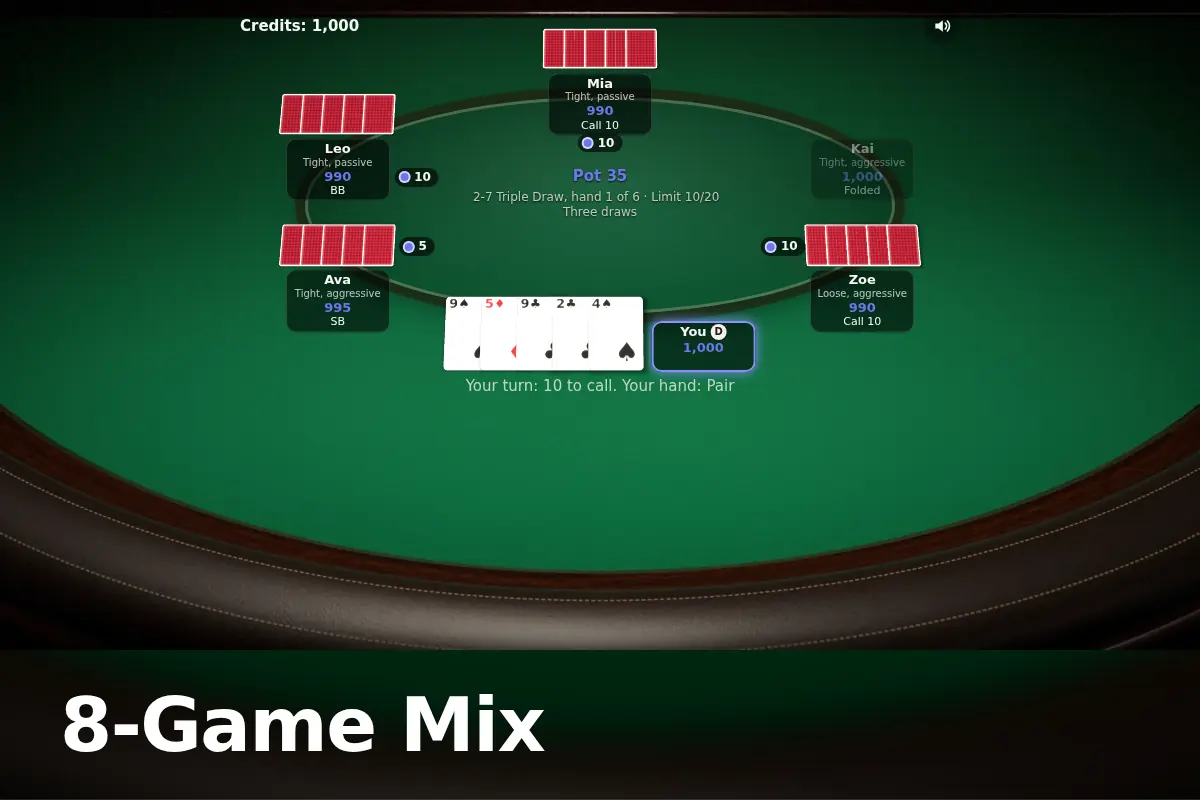
Read the labels. Every computer player shows Tight or Loose, and aggressive or passive. Tight players fold a lot, so attack their blinds; loose players call more, so value-bet them and bluff them less. A passive player who suddenly raises big usually has it.
Heads-up is a different game. With two players left you post a blind every hand. Hands like any ace, any pair or two high cards are worth playing, and waiting for a premium hand lets the blinds eat your stack.
More poker. For a cash table where opponents are replaced when they go broke and you can leave with your chips, play Texas Hold’em. To play against a dealer instead, try Hold’em Duel.
If you enjoy Hold’em Sit & Go, try HORSE Poker or Horse Race next.