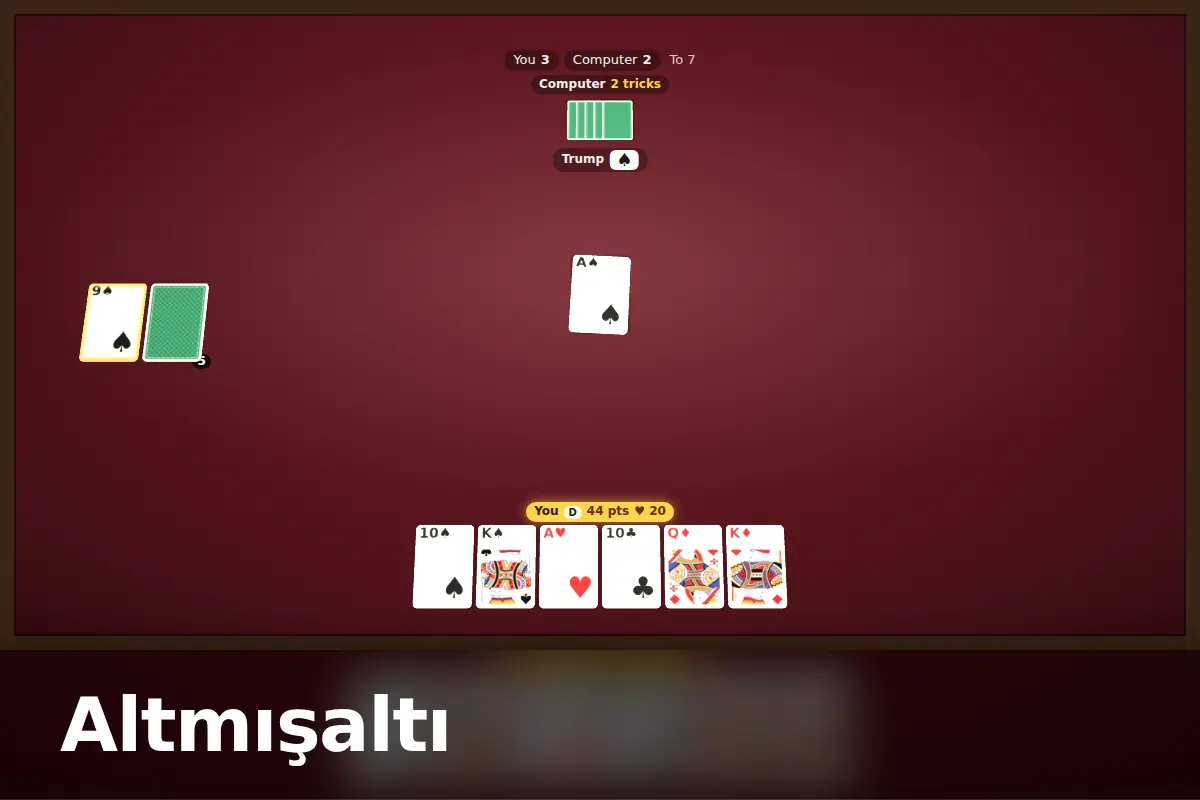
Oh Hell, also called Nomination Whist, is the trick-taking game where taking too many tricks is as bad as taking too few. Every hand you name the exact number of tricks you expect to win, then try to land on that number and not one more. You sit at the bottom of the table against three computer players; everyone plays for themselves.
How to play
The hands. A full match is 19 hands: the first hand deals 1 card to each player, the next 2, and so on up to 10, then back down to 1. Choose Hands 7 at the top for a short match that starts at 7 cards and shrinks to 1. The deal passes to the next seat every hand, moving to the right around the table.
Trumps. After the deal, the next card of the deck is turned face up in the middle. Its suit is trumps for the hand; the card itself stays out of play.
Bidding. Starting with the player after the dealer, everyone says how many tricks they will take, from 0 up to the number of cards in the hand. The dealer bids last. With Dealer block on (the default), the dealer may not choose the number that would make all four bids add up exactly to the number of tricks: someone is guaranteed to miss. Bids cannot be changed.
Play. The first bidder leads. You must follow suit if you can; otherwise you may play anything, including a trump. The highest trump wins the trick, or the highest card of the suit led if nobody trumped. The winner leads the next trick.
Scoring. Take exactly your bid and you score 10 points plus your bid, so a successful bid of 0 is worth 10 and a successful bid of 3 is worth 13. Miss by any amount and you score nothing for the hand. Turn on −1 per miss to lose 1 point for every trick you are off instead. After the last hand the highest total wins; ties are shared.
Controls. Tap a bid button when it is your turn, then tap a highlighted card to play it. Hint shows the bid or card the computer would choose. The game is saved after every move, so you can close the page and continue later. New game in the middle of a match counts as giving up.
Strategy
Count sure tricks, then subtract for small hands. The ace of trumps is always a trick. A side-suit ace is only a trick if nobody trumps it, and in a 1 or 2 card hand two of your three opponents are usually out of your suit. In the smallest hands bid 0 unless you hold a high trump.
Low cards are a resource. Once your bid is complete, every trick you win is a disaster. Keep a couple of very low cards so you can duck under whatever is led, and get rid of middle cards early while someone else is winning the trick.
Watch the total of the bids. If the bids before you add up to more than the number of tricks, somebody has to fall short, and it is easier to lose a trick on purpose than to win one. Lean towards the lower of two plausible bids when the table is overbid, and higher when it is underbid.
Use the dealer block against the dealer. When you bid before the dealer you can leave them with only unattractive options: if the dealer looks to be holding a strong hand, keep the total one below the number of tricks so the dealer cannot bid the single trick they wanted.
How often do bids come in? The built-in computer players make their bid in about 50% of hands over a full 19-hand match: around 69% of 1-card hands but only 29% of 10-card hands, where there are many more ways to be off by one. The winner of a full match averages about 127 points, and about 57 in the 7-hand match.
If you enjoy Oh Hell, try Papaz Kaçtı or Partnership Batak next.