How to play
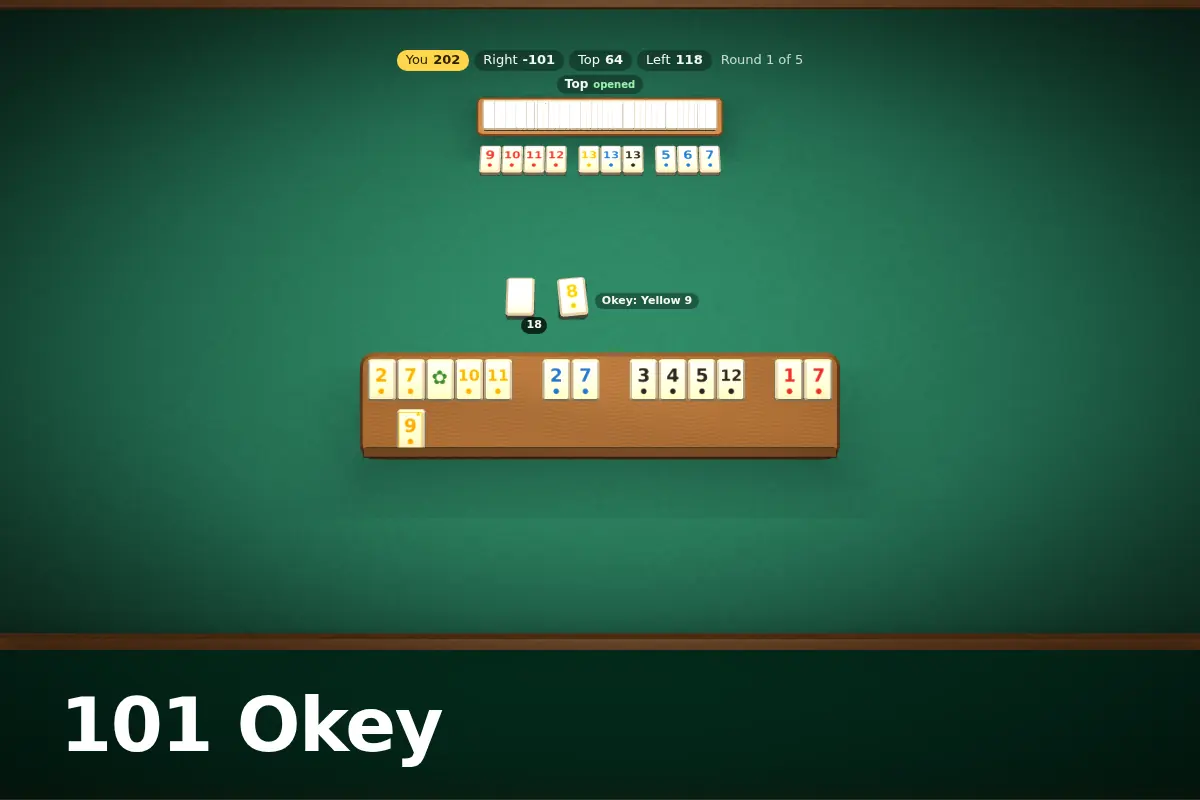
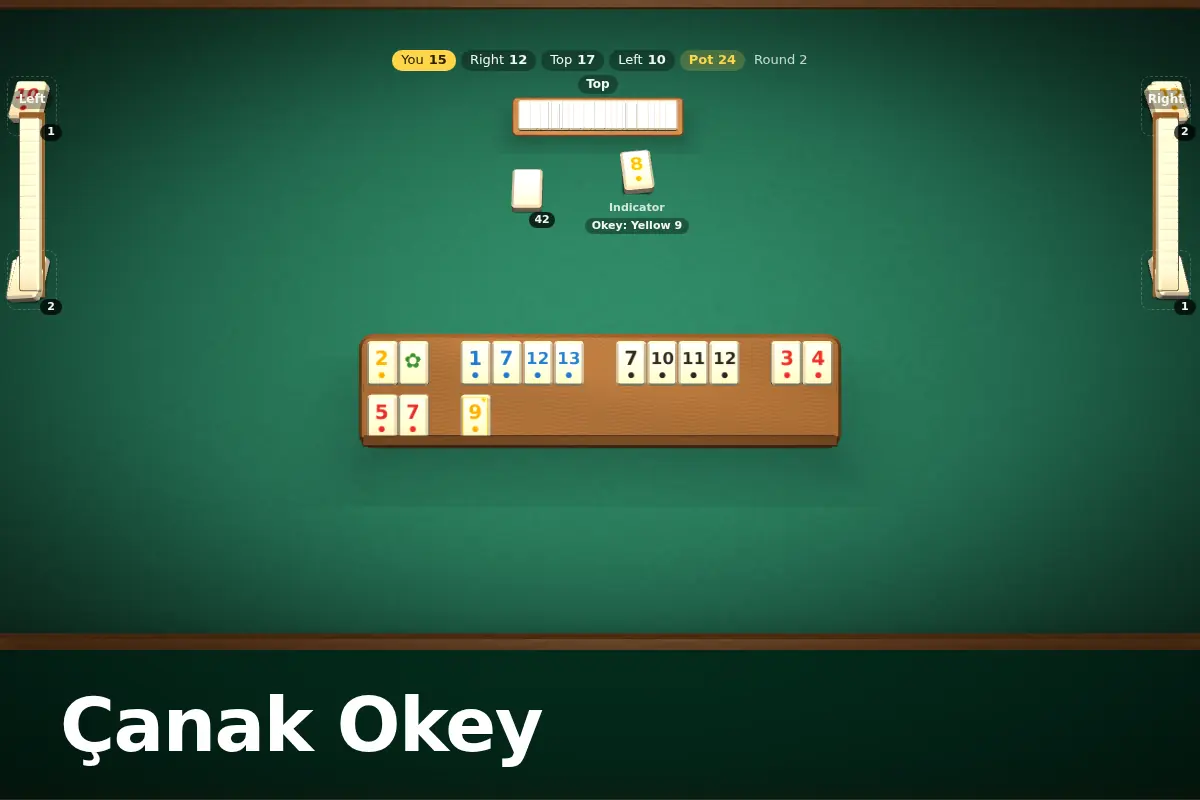
Eşli 101 is the team form of 101 Okey. The table play is identical; the difference is how a match is won. You and the computer player opposite you, marked Partner, share one score made of both your penalties added together, against the left and right seats as the other team.
If you know solo 101 you can skip to the next section. The essentials in brief:
- Dealer holds 22 tiles and throws first; the others hold 21. Play runs counterclockwise.
- The indicator sets the okey (next number, same colour), which is wild. False jokers play as the okey’s value.
- Draw from the middle, or take the left opponent’s discard only when you can put it down this turn.
- Nothing hits the table until you open with sets totalling 101 or more, or with five pairs. Use Set aside for each set, then Open.
- From the following turn, Lay set puts down new sets and a tapped set on the table accepts a matching tile.
- Runs start no lower than 1 and stop at 13 (12-13-1 doesn’t count). Groups are one number in three or four colours.
- The first player to discard their final tile ends the round.
The Rounds buttons give a match of 3, 5 or 9 rounds.
Team scoring
Each player is scored exactly as in solo 101, and then partners’ numbers are summed:
| Your round | Your penalty |
|---|---|
| You went out | -101 |
| You went out throwing an okey | -202 |
| You never opened | +202 |
| You opened with sets | tiles left in hand |
| You opened with pairs | twice the tiles left |
The top bar shows Your team against Other team, and the round summary does the same. After the final round, the team with the lower combined total wins together.
This has a consequence that surprises people coming from Partnership Okey. There, a partner’s finish is all that matters. Here, your partner going out gives the team -101, but your own hand is still counted. If you never opened, your +202 more than cancels the bonus and the team ends the round worse off. Both players have to open.
Working with your partner
Seats alternate teams, so the player whose discard you can pick up is always an opponent, and so is the one who gets yours. Your partner is two seats away in both directions. Tiles can’t pass between you through the discard piles.
The table is a different story. Every set laid down is open to anyone who has opened, so your partner’s runs and groups are places to dump your tiles, and yours are places for theirs. A long run laid by your partner might take your stray 9 and 10, and those are 19 points that no longer count against the team.
The other side’s sets work the same way, of course, so watch what you lay. A run that sits open at both ends gives opponents an easy place to shed tiles too.
Strategy
Open before anything else. Two +202s in a round is a hole a team rarely climbs out of. If you and your partner are both close, open with the plainest sets you have and save cleverness for later.
Don’t race your partner. Once one of you is likely to go out, the other’s job is to shrink their hand: put high tiles on the table and keep low ones. A -101 plus your leftover 8 points is a far better round than a -101 plus 60.
Reading the partner. The computer partner plays its own hand and doesn’t signal. Watch its sets on the table instead: what it lays tells you which numbers and colours it’s collecting, and which tiles you can safely add.
Starve the right-hand opponent. They’re the only one who can take your discard, and only if they can use it right away. Throw tiles that fit nothing on the table and nothing near the sets they’ve laid.
Pairs cost more as a team. Opening with pairs doubles whatever is left in your hand, and you can only lay pairs afterwards. It can rescue you from +202, but it rarely helps the team total otherwise.