Spider Solitaire Strategy for 1, 2 and 4 Suits
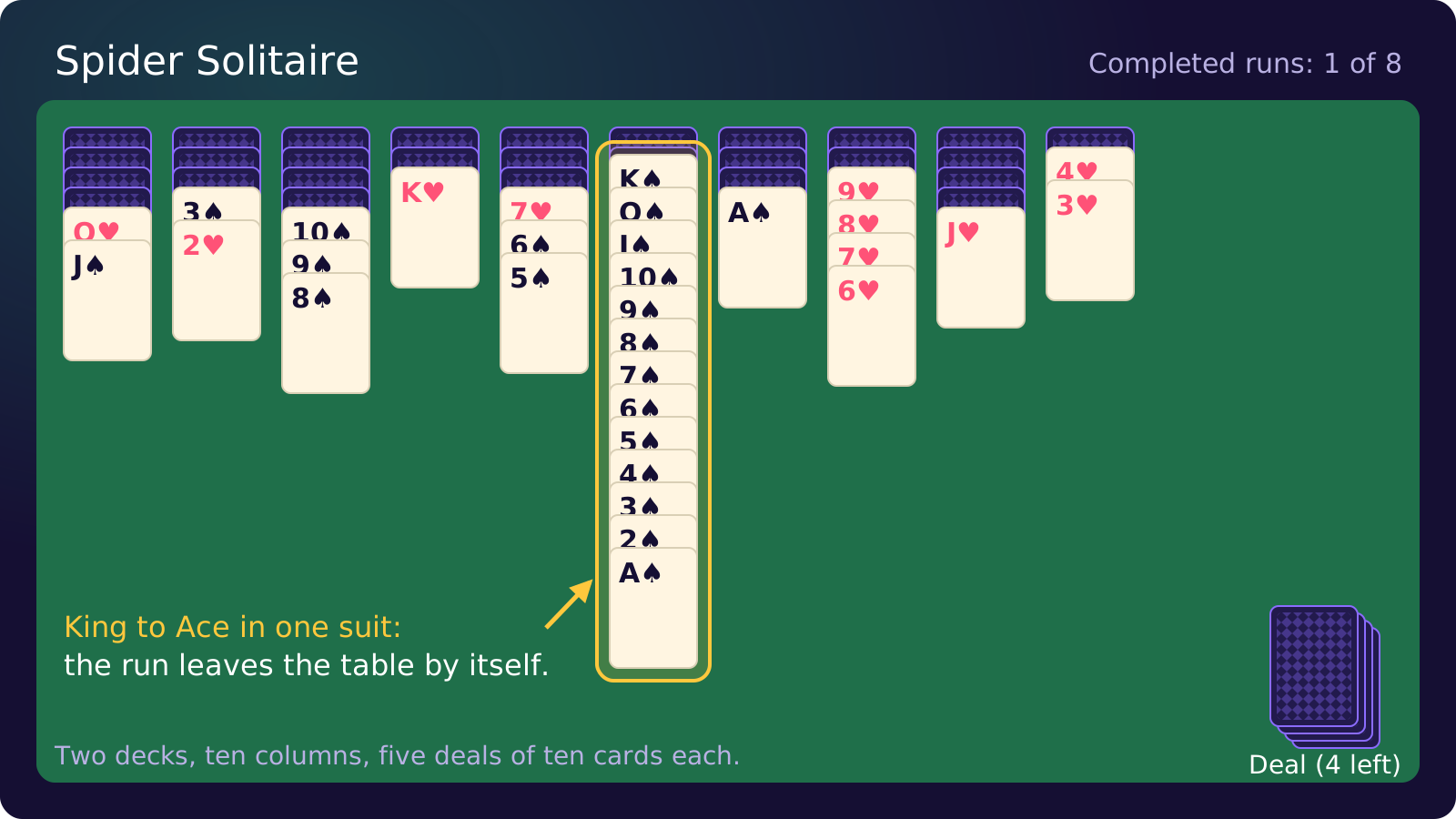
Forty-four of the 104 cards start face down. Ten are showing, fifty wait in the stock, and every one of those fifty will land on top of something you’ve built. That’s the whole tension of Spider: you have to dig, and the stock keeps refilling the hole.
Spider Solitaire on DiceGem plays with 1, 2 or 4 suits, five stock deals, a deep undo and a saved game you can walk away from. The rules take a minute. Playing well takes a thinking order, and the order changes with the suit count. What follows is the one I use, built from how our rules code decides what is legal: in-suit building first, then empty columns, then the stock, with adjustments for each difficulty at the end.
The rules that shape every decision
Three rules do almost all the work in Spider, and the strategy falls out of them.
- Any card goes on a card one rank higher, but only a run in one suit moves as a group. A 7♥ sits happily on an 8♠. It just can’t travel with it later.
- A deal drops one card on all ten columns, and the game refuses to deal while any column is empty. The button reads “Fill every column before dealing” until you do.
- A King-to-Ace run in a single suit is removed the moment it is complete at the end of a column, and the card underneath turns over. You never move runs to a foundation by hand.
Two decks means eight sets of thirteen. With 1 suit all eight sets are spades. With 2 suits you get four spade sets and four heart sets. With 4 suits it’s two of each. There are always eight Kings and eight Aces on the table by the end; what changes is how many of them compete for the same column.
The deal itself is fixed: six cards in each of the first four columns, five in the other six, one face up per column. That leaves 44 face-down cards and 50 in the stock, which is exactly five deals of ten. The stock never comes back around the way it does in Klondike. Once the fifth deal is out, what you see is all there is.
Undo here is deep and it survives a page reload. It also steps back through a stock deal. I treat it as part of the game rather than a cheat, and I’ll say where it earns its keep below.
Build in suit: natural versus mixed builds
When two spots accept a card, choose the one in the same suit, even if the mixed spot looks tidier or sits on a longer stack.
A natural build is a descending run in one suit: 9♠ 8♠ 7♠. The game’s movableRun check counts it as one piece, so it moves as one piece. A mixed build has the right ranks and the wrong suits: 9♠ 8♥ 7♠. It looks the same on the table and behaves completely differently. To move that stack you need an empty column to park the 7♠, another spot for the 8♥, and only then does the 9♠ go anywhere.
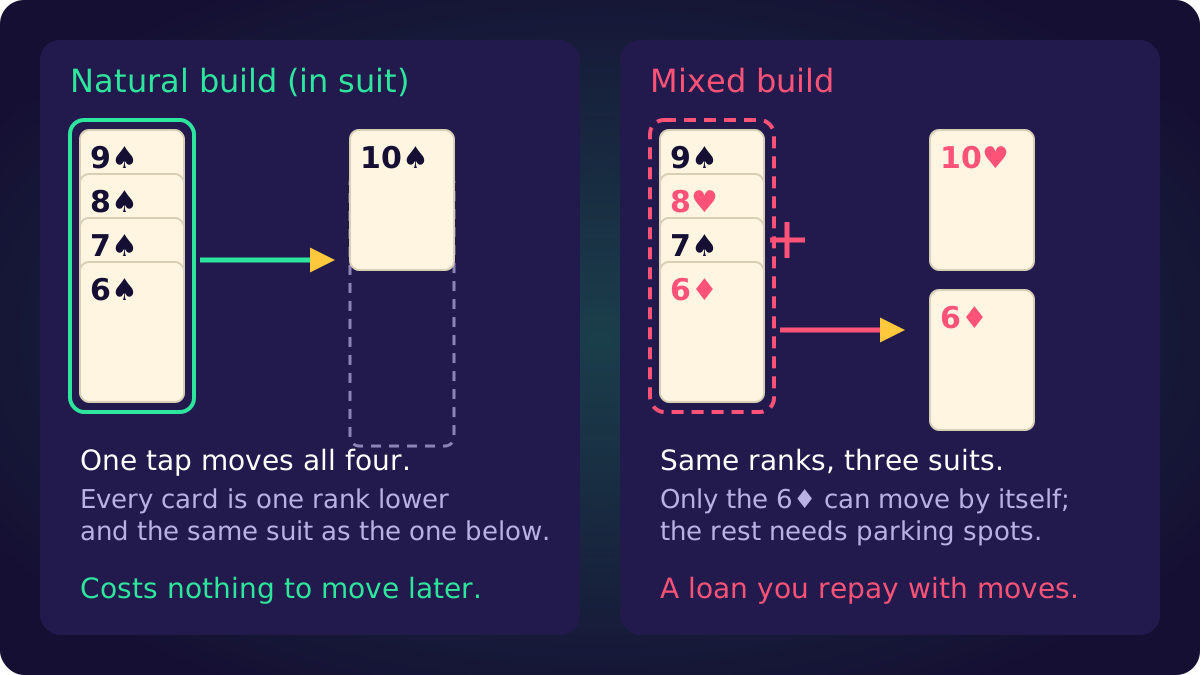
Mixed builds aren’t forbidden. They’re a loan. You get a card out of the way now, and you repay it later with extra moves and usually a column. The interest rate goes up with the suit count: in 1 suit there’s no such thing as a mixed build, in 2 suits half your placements are at risk of being mixed, in 4 suits most of them are unless you plan.
When a card has several legal homes, I run down this list and stop at the first match:
- Same suit, and the move flips a face-down card or empties a column.
- Same suit, anywhere.
- Mixed, and the move flips a face-down card.
- Mixed, with no flip, only if it sets up a specific next move you can name.
- An empty column, for a single card, almost never.
Tapping a card does something close to this for you. Our tap-to-move scores every legal destination and prefers a flip, then an in-suit join, then any rank join, and it only uses an empty column when no card accepts the stack. Tap a card lower down in a run to move just the part from that card upward. What tapping can’t do is see two moves ahead, and that’s where the rest of this page comes in.
How to make an empty column early
Target the column that needs the fewest moves to empty, which at the start is one of the six five-card columns on the right, not the column with the most face-down cards.
That sounds like it contradicts the advice on the game page to dig the deepest columns first. It doesn’t, quite. Digging a deep column buys information. Emptying a short column buys mobility, and early on mobility is what turns information into progress. The right-hand six columns start with four face-down cards; the left four start with five. One card doesn’t sound like much until you realise every flip needs a legal destination for the card you’re moving.
Worked position 1: three moves to a free column
Two suits, just after the first deal. Column 8 holds one face-down card with a 5♥ on top. Column 2 ends in a 6♥. Column 5 ends in a Q♠. Column 4 ends 10♠ 9♥, and column 6 ends 9♠ 8♠ 7♠ with a face-down card under the 9♠.
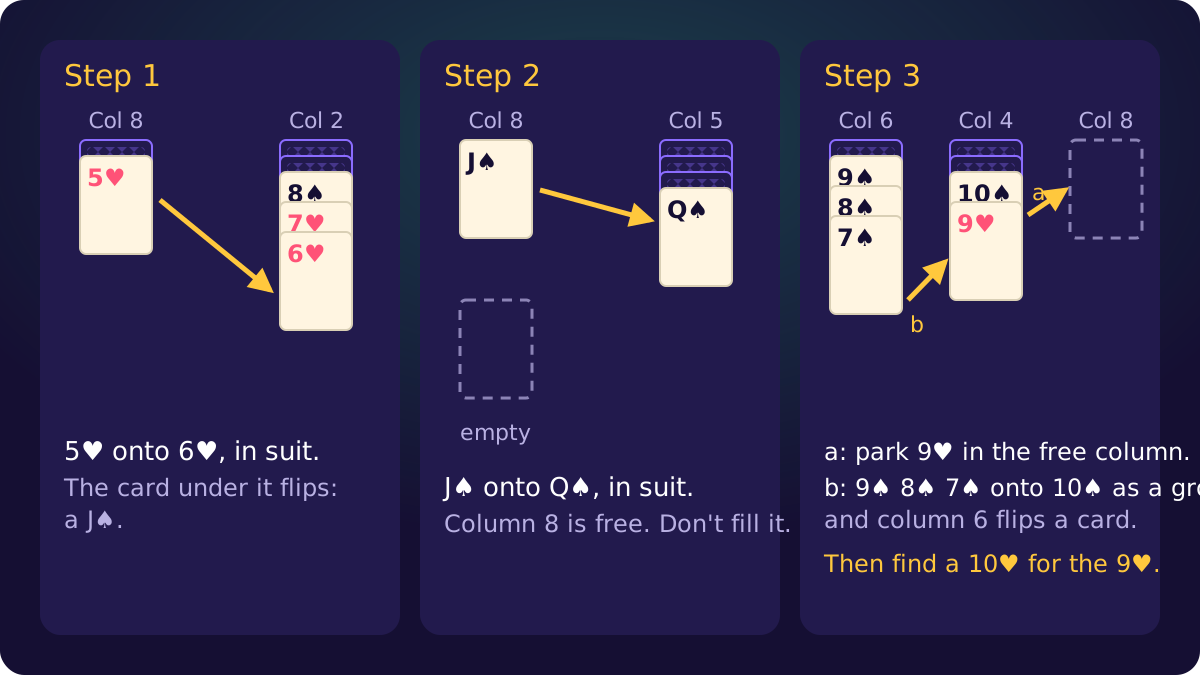
Step one: the 5♥ goes onto the 6♥. In suit, and it flips the last face-down card in column 8, which turns out to be a J♠. Step two: the J♠ goes onto the Q♠ in column 5, also in suit. Column 8 is now empty. Two moves, two natural joins, one free column.
Step three is the part people skip. Don’t fill the column. Use it. The 9♥ on column 4 is sitting on a 10♠, a mixed build that’s blocking a natural one. Park the 9♥ in the empty column, slide 9♠ 8♠ 7♠ as a group onto the 10♠, and the face-down card under the old 9♠ flips. Column 6 is one card from empty too. Now look for a 10♥ to take the 9♥ back out of the free column and you’re ahead by two flips and a natural four-card run.
What an empty column is actually for
- It’s the only place a King can go. A King sitting on face-down cards is a plug until a column opens.
- It’s the only way to take a mixed stack apart and rebuild it in suit, as in step three above.
- It’s a buffer for the deal. If you deal with an empty column you have to fill it first, and a column with a single sensible card in it survives a deal far better than one with a jumble.
Filling a free column with a lone card for no reason is the most expensive move in the game. The exception is a King that is blocking face-down cards you need: moving it into the column costs the column but unplugs a whole stack.
When to deal from the stock
Deal only when no move is left that flips a card, joins a run in suit, or clears a column, and when you’ve checked all ten columns, not just the ones you were working on.
The deal covers everything. Ten cards land, one per column, and every run you were building now has a stranger on top. The run underneath is still intact, so a stack of 8♠ 7♠ 6♠ with a 3♦ dealt onto it is still a stack of 8♠ 7♠ 6♠ once the 3♦ moves. But that 3♦ has to go somewhere, and so do the other nine.
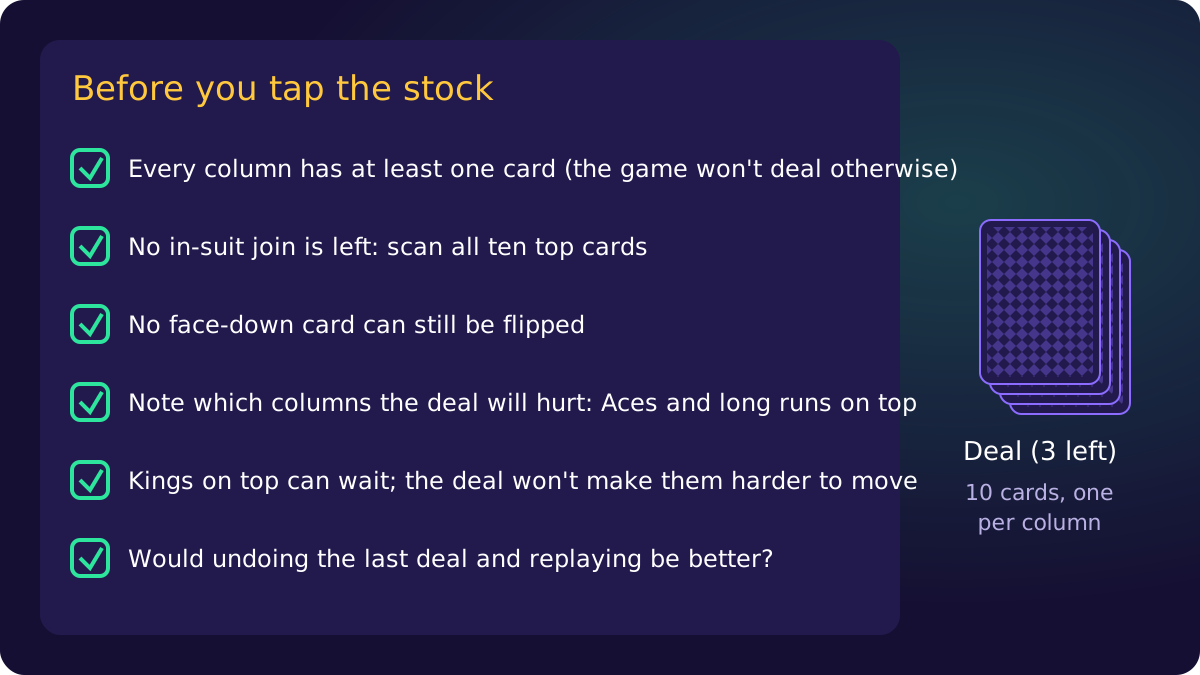
Before each tap of the stock I go through this list, in order:
- Does every column have a card? The game won’t deal otherwise. If one is empty, decide what fills it now, not after the next move.
- Is any in-suit join still available? Scan the ten top cards and look for the card one rank higher in the same suit. These cost nothing and the deal will hide them.
- Can any face-down card still be flipped? A single move that flips is almost always worth making before the deal, even a mixed one.
- Which columns will the deal hurt most? A column ending in an Ace, or in a long natural run, is about to be capped. Can either be moved first?
- Are the Kings on top handled? If a King sits on top of a column and you have an empty column coming, deal first and move the King after, because the deal won’t make it any harder to move.
- Do you want to undo the previous deal instead? If the last ten cards gave you nothing, undoing them and trying a different order of moves is allowed and often better.
Five deals is not many. By the third deal you want at least two columns that are long natural runs, because then the dealt cards on top of them are single cards with an obvious destination. By the fifth deal the stock is gone and you’re playing a pure rearrangement puzzle with whatever structure you built.
The same look-before-you-move habit is what the solving techniques in Sudoku rely on: the cheap move is to scan the whole grid before touching anything, and the expensive mistake is to act on the first thing you noticed.
Kings, low cards and partial runs
What sits on top of face-down cards matters more than what’s buried under them, because every card is needed eventually and only the exposed cards decide what you can do next.
Digging for Kings versus burying low cards
A King can only move to an empty column, so a King on top of a column is a plug. An Ace on top is a different kind of problem: nothing can be placed on it, so the column stops growing until a 2 is exposed somewhere for it to move onto. Those are the two shapes to worry about. A buried 2 is fine; you’ll reach it when you dig, and by then you’ll have 3s to receive it.
Where this gets interesting is the choice between digging a column to reach a King you suspect is there, and leaving it alone because the dig would bury low cards under a mixed stack. My rule: dig if the dig creates natural builds along the way. Don’t dig if the only way through is three mixed placements in a row. A King you can’t yet house is no better face up than face down.
Moving partial runs to expose a better card
You can move the top few cards of a natural run and leave the rest. That’s not a waste; it’s often the key move. Suppose a column ends 10♥ 9♠ 8♠. Tapping the 9♠ moves 9♠ 8♠ together onto a 10♠ elsewhere, making that stack natural, and the 10♥ left behind is now free to take a 9♥. One move, two improvements.
Worked position 2: the end game with no stock left
Four suits, all five deals used. Column 3 holds K♦ down to 7♦, seven diamonds in a row, capped by 6♣ 5♣. Column 7 ends 6♦ 5♦ 4♦ 3♦ 2♦ A♦. Column 9 has a 7♣ on top.
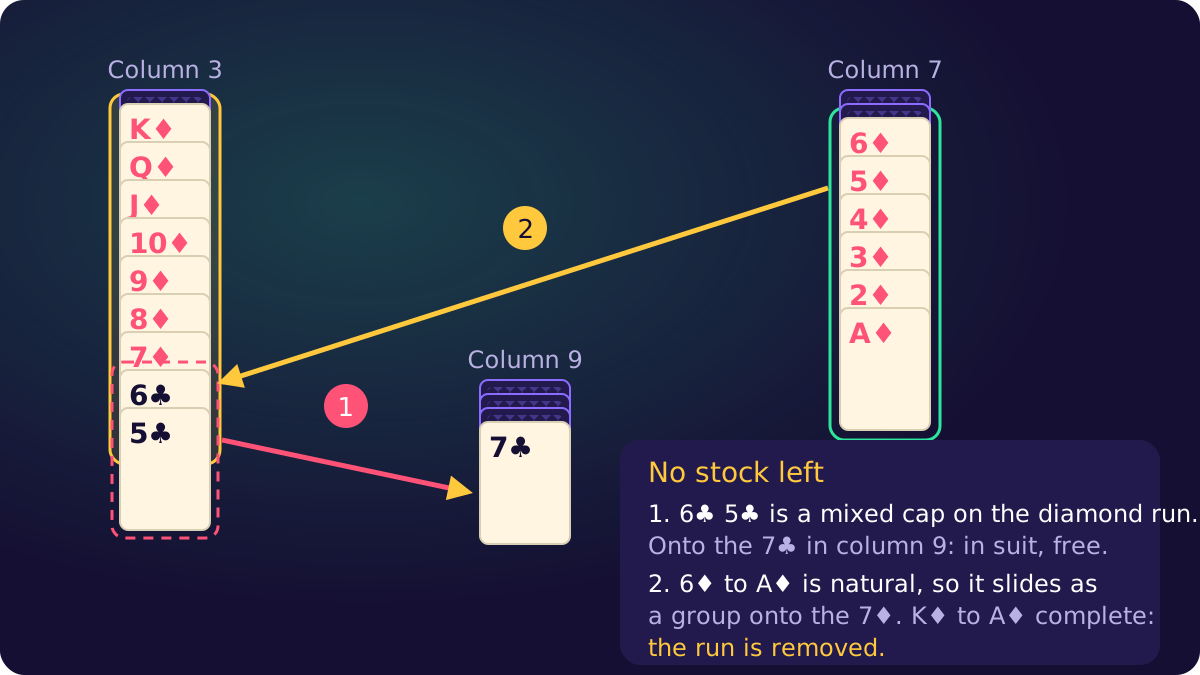
The 6♣ 5♣ pair is a mixed cap on a natural run. Move it onto the 7♣ in column 9, which is a natural join, so the move is free. Then the six-card diamond run on column 7 slides as a group onto the 7♦, the thirteen cards from K♦ to A♦ are complete at the end of the column, and the game removes them and flips whatever was under the King. That’s the end game in one sentence: find the mixed cap, find its natural home, and the run finishes itself.
With no stock left, there’s no more covering, so you can finally afford moves that don’t flip anything. Count the cards of each suit still on the table and work backwards from the Kings. If a run can’t be completed because its Ace is under another suit’s King, the empty column is the only way out, and that’s why you saved one.
Strategy by difficulty
The core order (in suit, empty column, then deal) holds at every setting. What changes is how much of your attention each step deserves.
1 suit: speed and learning
With only spades, every descending stack is natural, so the whole “mixed build” problem disappears. The game becomes about two things: making empty columns and timing the deal. That makes 1 suit the right place to learn the pre-deal checklist until it’s automatic. Watch the move counter and the clock in the top bar and try to bring both down over a few games. Nearly every 1-suit deal can be won with patience and undo, so a loss here usually means a deal came too early.
2 suits: colour management
Spades and hearts, four sets each. Half of all placements can be natural if you look for them, and the discipline is to keep hearts with hearts and spades with spades. When you’re forced to mix, mix near the top of a column, where the offending card will be moved soon, not at the base, where it’ll sit under everything. Keep a running sense of which columns are “heart columns” and which are “spade columns” and route cards accordingly. If you find yourself with three mixed stacks and no empty column, that’s the moment to undo a few moves rather than deal.
4 suits: planning, rarely rushing
Two sets of each suit, so almost every placement is mixed unless you plan for it. Slow down. Before the first deal, try to have one empty column and at least one natural run of four or more. Decide which suit owns each column and be reluctant to break that. Use undo freely to try a different order of moves after a bad deal. Accept that some 4-suit deals can’t be won however you play, and judge yourself on whether you made the right decisions, the same way the chart in blackjack basic strategy is right even on the hands it loses. The pleasure of 4 suits is that a win is earned.
Common mistakes
- Dealing with moves left. The most common one by far. The fix is the checklist, and the habit of scanning all ten columns, not the three you were busy with.
- Filling an empty column with a lone card to tidy up. A free column is the most valuable thing on the table. Fill it only with a King, or as part of a sequence that empties it again.
- Building mixed when a same-suit target was one column over. Tap-to-move prefers the same suit, but it only sees one move. Look before you tap.
- Ignoring an Ace on top. The column is dead until a 2 appears. If you have the choice, don’t let the deal cap an Ace with something unrelated.
- Moving a run because it can move. In 4 suits a move that doesn’t flip, join in suit, or free a column just changes what the next deal covers. If you can’t name what it gains, don’t make it.
- Using the stock as a reset button. It isn’t. Each deal is ten cards of new cover and you only get five. Undo is the reset button.
Spider against Klondike, FreeCell and Scorpion
Spider is the only one of our solitaires where the stock covers your work instead of feeding it, and that single rule is why its strategy is so different from the others on the card games shelf.
In Klondike the stock cycles, so a card you pass on comes around again, and the foundations take cards one at a time from the Ace up. Our Klondike strategy guide spends most of its time on Draw 3 counting for exactly that reason. Spider has no foundations and no second pass. The equivalent of foundation play is keeping runs natural so the game can remove them itself.
FreeCell deals every card face up, so there’s no luck after the shuffle and almost every deal is winnable. Its free cells do the job Spider’s empty columns do, with a hard limit on how many cards you can move at once. If you like the empty-column planning in Spider, FreeCell is the purest version of that puzzle.
Scorpion is the one that looks like Spider and plays nothing like it. Cards go only on the same suit, you can pick up any face-up card with the jumble on top of it, and empty columns accept only Kings. Scorpion’s “any card with its pile” rule means mixed stacks aren’t a loan, they’re free. Spider’s whole game is that they aren’t.
Pick a suit count, make an empty column before you touch the stock, and run the checklist before each deal. Then open Spider Solitaire, start with 2 suits, and see how far the first free column gets you.
Frequently asked questions
Is there a Spider Solitaire strategy for 3 suits?
Our game offers 1, 2 and 4 suits, so there is no 3-suit mode to practise on. If you find 4 suits too hard after 2, the advice for 4 suits still applies: keep every column natural where you can, make an empty column before the first deal, and treat a mixed placement as a temporary parking spot rather than a build.
Are there Spider Solitaire cheats?
The only tool the game gives you is undo, and it is a legitimate part of the rules here. Undo steps back through hundreds of moves, including a stock deal, and the history is saved with your game. Using it to scout what a deal brings and then replaying the position differently is allowed; nothing else alters the shuffle.
What are the Spider Solitaire rules for one deck?
Our game always uses two decks, 104 cards, with ten columns and five stock deals. Single-deck variants exist under other names, but we do not offer one, and the strategy on this page assumes the two-deck layout. For a lighter game, pick 1 suit rather than a smaller deck: the layout stays the same and every stack moves as a group.
Is there a Spider Solitaire rules PDF?
We do not publish a PDF, because the rules fit in four lines. Any card goes on a card one rank higher. Only a same-suit run moves together. Tapping the stock deals one card on every column, five times in all, and only when no column is empty. A King-to-Ace run in one suit leaves the table by itself; clear eight and you win.