Sudoku Solving Techniques, From Singles to X-Wing
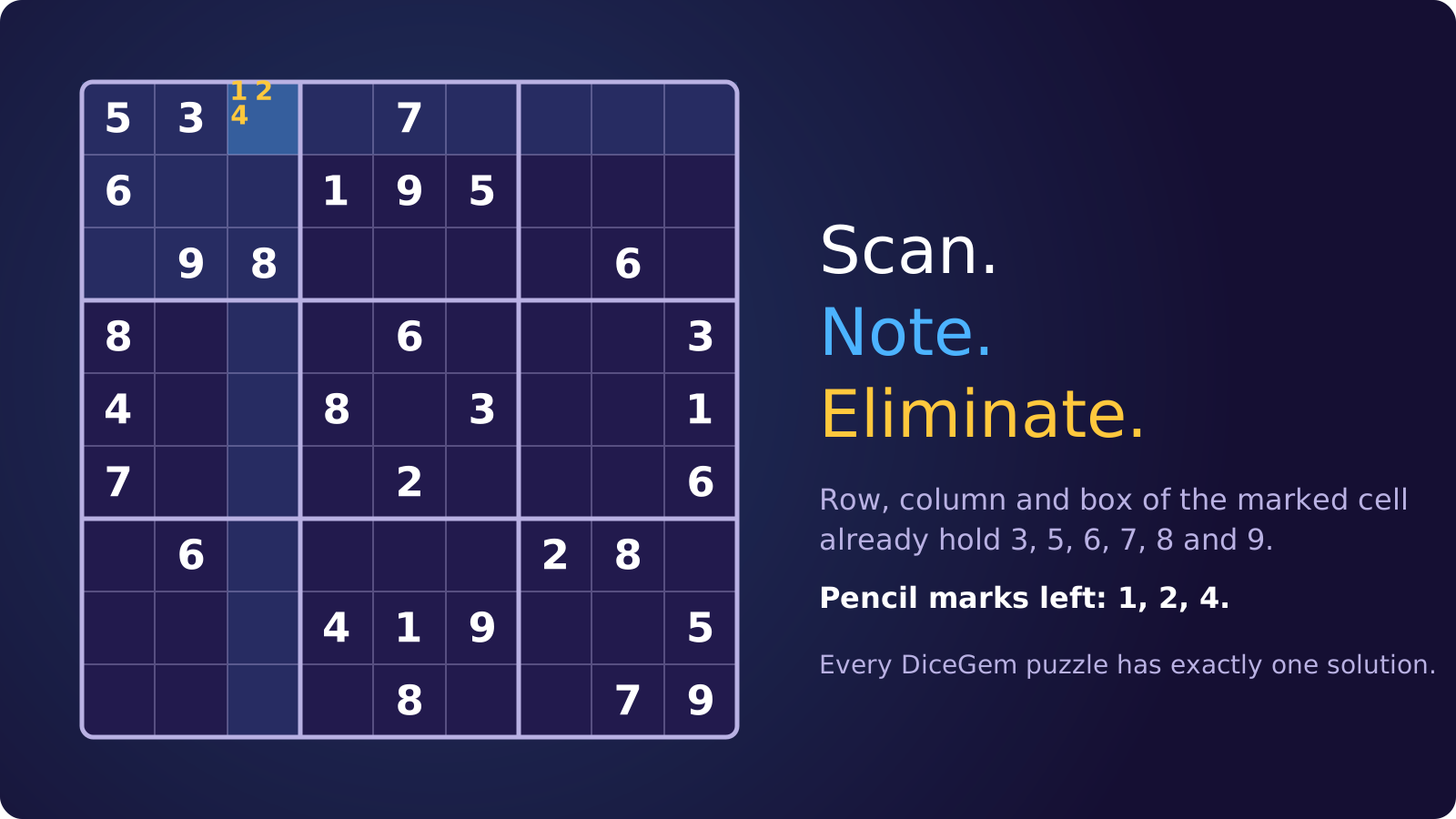
Six 7s already sit on the board. The seventh, eighth and ninth are usually the fastest digits you’ll place all game, and finding them needs no notes at all: tap a 7, watch every 7 light up, and look at the three boxes that still lack one. That habit, pick the most-placed digit and hunt its last homes, is the first rung of a ladder that runs all the way to X-Wing.
Everything below is written against our own Sudoku, whose generator and solver I maintain. That matters because the techniques only pay off if you trust the grid. Ours earns that trust in code: a puzzle is handed to you only after a solver has counted its solutions and found exactly one.
What the puzzle guarantees before you start
Every puzzle on the site has one solution, and the difficulty label tells you which techniques will be needed. Both facts come straight from the generator, so it’s worth knowing how it works.
The generator fills a random valid grid, then removes clues one at a time in a shuffled order. After each removal it runs a counting solver that stops as soon as it finds a second solution. If the puzzle is no longer unique, the clue goes back. That check is the whole reason guessing is pointless: there is one answer, and logic can always reach it.
Difficulty is not a score. It’s a test of which solver finishes the puzzle:
| Level | Clues at start | What the generator requires |
|---|---|---|
| Easy | 38 | Stays unique and solvable by singles alone after every removal |
| Medium | about 30 | Same singles test, fewer clues, so scans take longer |
| Hard | roughly 23 to 27 | Stays unique; the singles solver must get stuck |
For Easy and Medium, a clue is removed only if a solver that knows nothing but naked and hidden singles can still finish the grid. For Hard, the generator keeps removing clues as long as the puzzle stays unique, aiming for as few as it can reach, then checks that the singles solver fails. If it doesn’t fail, the whole grid is thrown away and generated again, up to a dozen times. So a Hard label is a promise that at some point you’ll need notes and at least pair logic.
The lowest possible clue count for any uniquely solvable Sudoku is 17. That isn’t folklore: McGuire, Tugemann and Civario proved it by exhaustive search in There is no 16-Clue Sudoku. Our Hard generator aims at that floor but a random removal order gets stuck well before it, which is why you see the low twenties in practice.
Three features of the app change how you should play:
- Notes are per-cell pencil marks. When you place a digit, the matching note is wiped from every cell in that row, column and box automatically. Keep notes honest and the app maintains them for you.
- Mistakes are checked against the solution, not just against the visible board. A red digit is wrong; a pink cell merely clashes with a peer. Three mistakes end the game, and Second Chance takes back the move that caused the third.
- Hint first repairs any wrong digit on the board. If nothing is wrong, it fills the empty cell with the fewest candidates. A hint may show a short optional ad first.
Scanning and singles
Singles are the only technique Easy and Medium ever require, and the only ones that place a digit directly. Everything higher on the ladder removes candidates so that a single can appear.
Cross-hatching for hidden singles
A hidden single is a digit with exactly one legal cell inside a row, column or box. To spot one, pick a box and a digit it’s missing, then cross out every row and column that already holds that digit. If a single empty cell survives, the digit lives there.
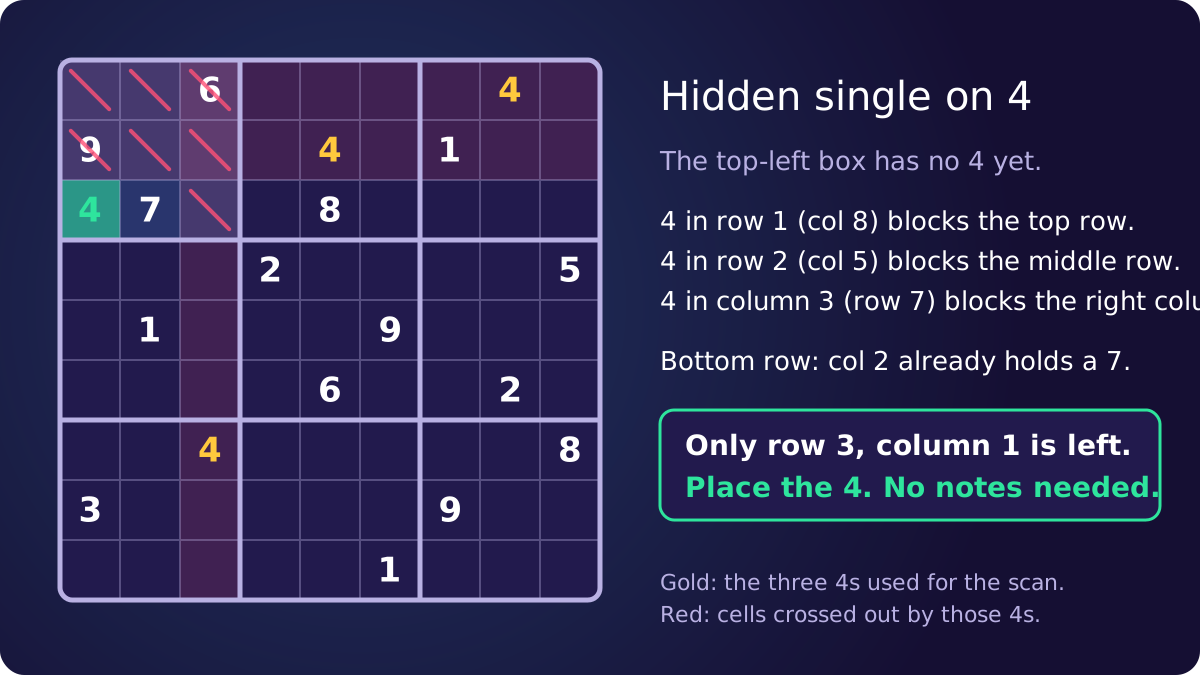
In the diagram the top-left box has no 4. A 4 in row 1 (column 8) rules out the whole top row of the box, a 4 in row 2 (column 5) rules out the middle row, and a 4 in column 3 (row 7) rules out the right column. Of the bottom row’s three cells only the first and second are left, and the second already holds a 7. Row 3, column 1 must be 4.
The one-sentence logic: a digit must appear once in every unit, so if only one cell in the unit can hold it, that cell does.
You don’t need notes for this, which is why it comes first. The cell in question might have four or five candidates of its own and you’d never know. Hidden singles are the cheapest move in Sudoku.
Naked singles
A naked single is the opposite view: a cell with exactly one candidate left. Check the cell against its row, column and box; if eight different digits already appear among those twenty peers, the ninth is forced.
Say the centre cell sees 1, 2, 3 and 4 in its row, 5 and 6 in its column, and 7 and 8 in its box. Only 9 is missing. Write it.
Naked singles are what the Hint button reveals when the board has no errors, because it picks the empty cell with the fewest candidates. If you ask for a hint on an Easy grid, you’ll almost always get a cell you could have found with a careful count.
The scanning loop
Do the two checks in a loop, always the hidden-single scan first:
- Pick the digit with the most copies on the board. The small counter under each number button shows how many are still missing, so the smallest counter is your target.
- Highlight it and cross-hatch every box that lacks it.
- Move to the next most-placed digit. After all nine, sweep the grid for cells with one candidate.
- Each placement removes candidates from twenty peers, so after a round of placements, start again from step 1.
An Easy puzzle rarely survives three rounds.
Pairs and triples
When a full scan places nothing, switch Notes on and fill the candidates of one region at a time. Pairs are the first pattern notes expose, and the first thing the Hard generator forces you to use.
Naked pairs
A naked pair is two cells in the same unit whose candidates are the same two digits. Suppose row 4 has two empty cells, in columns 2 and 7, both marked {3, 8}. One takes the 3 and the other takes the 8, you just don’t know which yet. Either way, both digits are spoken for, so 3 and 8 can be removed from every other cell in row 4.
If the two cells also share a box, the elimination applies to the box too.
The logic: two cells that can only hold the same two digits consume both of them, so no other cell in that unit can.
Naked triples
The same idea with three cells and three digits, with one twist that catches people out: the cells don’t each need all three candidates. Cells marked {1, 4}, {4, 6} and {1, 6} in one column form a naked triple on {1, 4, 6}, because between them they can only ever be those three digits. Remove 1, 4 and 6 from the rest of the column.
Triples are rarer than pairs and easy to miss when notes are messy, which is one argument for the discipline section below.
Hidden pairs
A hidden pair hides inside cells that carry extra candidates. Scan a box for a digit that fits in only two cells, then check whether a second digit is confined to the same two cells. If so, those cells are the pair.
Picture a box where 2 and 9 can each only go in the two bottom-right cells, marked {2, 5, 9} and {2, 6, 9}. Because 2 and 9 have nowhere else to go, those two cells must take them, and the extra 5 and 6 are deleted. The cells become a naked pair on {2, 9}, which may in turn clear more of the box.
The logic: if two digits are locked into two cells, those cells have no room for anything else.
Box-line interactions
Pointing pairs and box-line reduction are the bridge between pair logic and the fish patterns. They need notes, but only for a single digit at a time, so you can run them with the digit highlight rather than a full pencil-mark grid.
Pointing pairs
Look at one digit inside one box. If all of its candidate cells in that box sit in the same row (or column), the digit must land in that row within the box, so it can be removed from the rest of the row outside the box.
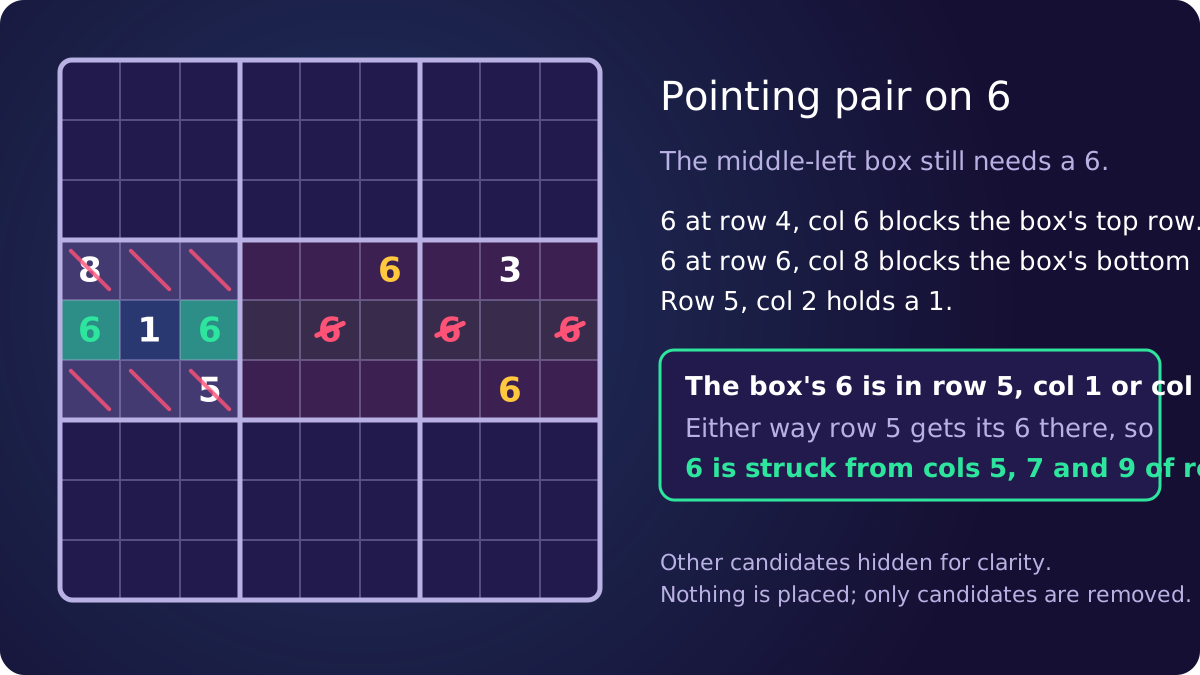
In the diagram, the middle-left box needs a 6. The 6 at row 4, column 6 blocks the top row of the box and the 6 at row 6, column 8 blocks the bottom row, so the box’s 6 must be in row 5, column 1 or column 3. Whichever it is, row 5 gets its 6 from the box, and the 6 candidates in columns 5, 7 and 9 of that row are gone.
The logic: a box’s copy of a digit confined to one line is also that line’s copy, so the line has no room for another.
Box-line reduction
The mirror image. Take one digit and one row. If every candidate cell for that digit in the row falls inside one box, the box’s copy of the digit must be in that row, and the digit can be removed from the box’s other two rows.
Suppose 5 can only go in two cells of row 2, both inside the top-right box. The top-right box’s 5 is therefore in row 2, and any 5 pencilled into rows 1 or 3 of that box is wrong.
Pointing pairs and box-line reductions never place a digit by themselves. Their job is to strip a candidate so that a hidden or naked single appears somewhere else. After any elimination, go straight back to the scanning loop.
X-Wing, and what lies beyond
X-Wing is the first pattern that spans the whole grid. You won’t need it on our puzzles, since Hard stops at the point where singles fail rather than at the point where pairs fail, but it’s the natural top of the ladder and it shows how the bigger patterns think.
X-Wing
Pick a digit. Find two rows in which that digit has exactly two candidate cells each, and in which those cells lie in the same two columns. The four cells form a rectangle. The digit must occupy two opposite corners of it, one per row, which means both columns receive their copy of the digit from inside the rectangle. Remove the digit from every other cell of those two columns.
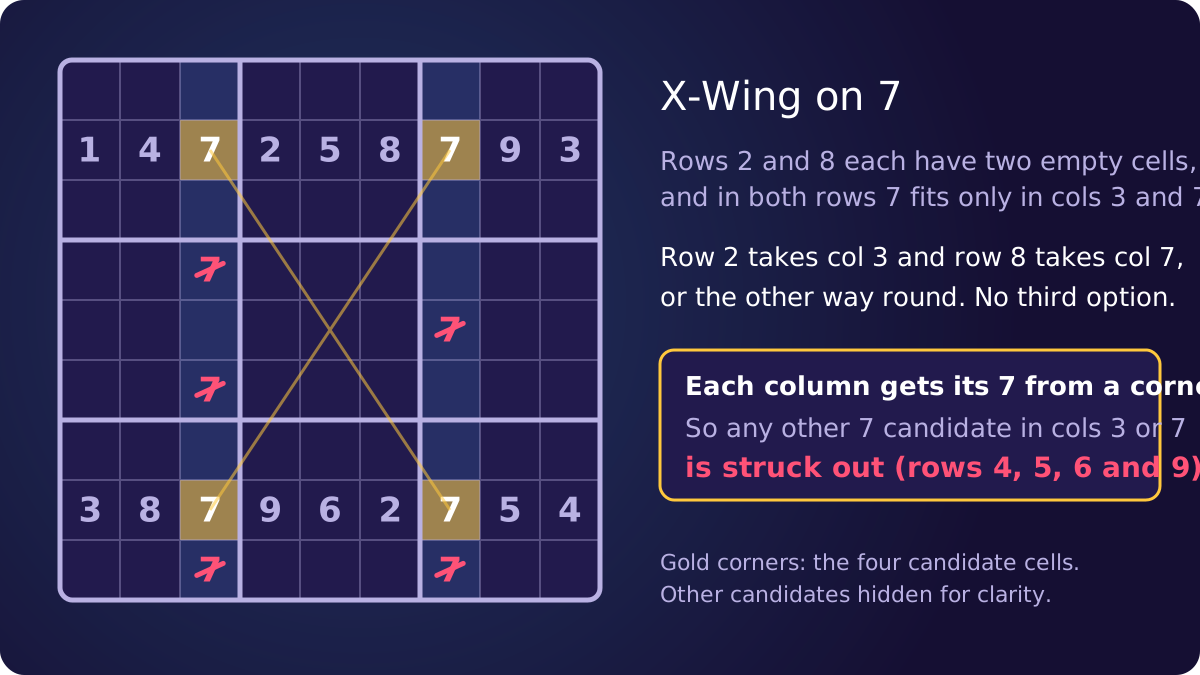
In the diagram rows 2 and 8 are nearly full, and in each the 7 can only go in column 3 or column 7. If row 2 puts its 7 in column 3, row 8 is forced into column 7, and the other way round. Either way, columns 3 and 7 are done with 7, so the struck-out 7s in rows 4, 5, 6 and 9 are eliminated.
The logic: two rows locked to the same two columns use up both columns’ copies of the digit.
The pattern also works rotated, with two columns locking two rows. What never changes is the count: exactly two candidates per base line, in matching positions.
Beyond this guide
Two names come up as soon as you search for harder patterns:
- Swordfish is an X-Wing with three rows and three columns. Each base row has its candidates within the same three columns (two or three per row), and the digit is removed from those columns elsewhere.
- Y-Wing chains three cells of two candidates each: a pivot {A, B} that sees two wings {A, C} and {B, C}. Whatever the pivot takes, one wing becomes C, so any cell that sees both wings cannot be C.
Both are real logic, not guessing, but neither will ever be required on a DiceGem grid.
Working a grid in order
The ladder above is also the order in which to try things, and the cheapest step that makes progress is always the right one.
- Scan for hidden singles by most-placed digit. No notes.
- Sweep for naked singles. Still no notes.
- Repeat 1 and 2 until a full pass changes nothing.
- Turn Notes on and pencil a region at a time, starting with the box or row that has the fewest empty cells.
- Look for naked pairs, then hidden pairs, then triples. Eliminate, then return to step 1.
- Run pointing pairs and box-line reduction digit by digit using the highlight.
- Only then think about X-Wing or anything bigger.
Hard puzzles usually break open at step 5. Once a pair clears a few notes, the singles return and the rest of the grid falls in a few rounds of scanning.
Note-taking discipline
Notes are only as good as their upkeep, and the app does half the work. When you place a digit, that digit’s note is removed from all twenty peers automatically. What it won’t do is add notes you forgot or remove ones that a pair or pointing pair makes impossible. Those are yours.
Three habits keep notes trustworthy:
- Pencil a complete unit or nothing. A box where some cells have notes and some don’t will hide hidden pairs, because the pattern depends on counting every cell.
- After every elimination technique, delete the eliminated candidates immediately, before you look for the next pattern.
- If you lose track, erase the notes in that region and redo them. The Erase key clears both the digit and the notes of a cell, and Undo restores notes as well as digits.
The planning muscle this builds carries over to other games. Layered solitaire rewards the same thing, thinking two eliminations ahead instead of taking the first legal move, which is most of what the Spider Solitaire strategy guide teaches.
Why you never need to guess
Every puzzle you see has passed a uniqueness check, and a uniquely solvable grid can always be finished with eliminations. That is not an assumption about your skill, it’s a property of the puzzle: if a candidate could be placed in a cell without breaking the rules but it’s not the solution, then somewhere a logical pattern rules it out, because otherwise the alternative would be a second solution.
Guessing on this board also costs you directly. A wrong digit turns red and counts toward the three-mistake limit, and the Hint button spends its move repairing your mistake instead of advancing the puzzle. If you’re stuck, a hint is cheaper than a guess.
Common mistakes
These are the errors behind most of the red digits I see when watching people play Hard:
- Scanning rows only. The hidden-single check works on columns and boxes too. Most missed singles live in a column.
- Writing a digit from a partial count. You saw seven peers and assumed the eighth. Count all twenty peers, or use notes.
- Treating a pair as placed. A naked pair tells you which two cells take two digits, not which digit goes where. The elimination is in the rest of the unit.
- Missing triples because a cell has only two candidates. {1, 4}, {4, 6} and {1, 6} are a triple. Count the union of candidates, not the size of each cell.
- Confusing a pink cell with a wrong cell. Pink means a clash with a visible digit and is always a rule violation. Red means the digit doesn’t match the solution. Both count as mistakes once placed, but pink you can see coming.
- Pencilling half a box. A hidden pair needs every cell of the unit marked. Half-marked regions produce confident, wrong eliminations.
- Skipping the rescan. After any elimination, singles appear. Jumping to the next advanced pattern instead of rescanning is the single biggest time sink.
The same deduction habits run through the rest of our puzzle games. Killer Sums adds cage totals on top of the Sudoku rules, Kakuro replaces the units with sums, and Futoshiki swaps boxes for inequality signs. If you want pure elimination with pictures instead of digits, Nonogram and Star Battle are the same scan-and-eliminate loop in a different costume.
Pick a Medium grid, place everything singles can give you before touching Notes, and time how long the first stall takes. Then try the same on Hard and watch where the pair shows up. The puzzle is waiting here, saved between visits, notes and all.
Frequently asked questions
What is the trick to solve Sudoku fast?
Speed comes from scanning in a fixed order rather than from any single trick. Pick the digit that already appears most often, highlight it, and cross-hatch each box that still needs it. Place every single you find before touching notes, because each placement removes candidates and creates new singles. Only switch to pencil marks when a full scan finds nothing.
Is there a trick to solve Sudoku?
There is no shortcut that skips the logic, but there is a reliable method. Every valid puzzle with one solution can be finished by a ladder of eliminations: singles, pairs, box-line interactions and fish patterns. Each step either places a digit or removes a candidate, and the grid is solved when no empty cell remains. Guessing is never needed.
What is the best Sudoku solving method?
The cheapest technique that makes progress is always the best one. Start with scanning for hidden singles, which needs no notes, then check each cell for a naked single. Add pencil marks only when a full pass stalls, then look for naked pairs, pointing pairs and box-line reductions before spending time on X-Wing or chains.
What are some advanced Sudoku solving techniques?
Beyond X-Wing, the common advanced patterns are Swordfish, which is an X-Wing stretched across three rows and columns, Y-Wing and XYZ-Wing, which chain three cells of two candidates, and the simple colouring and chain methods that follow a single digit around the grid. None of them is needed on DiceGem puzzles, which stop at pair-level logic.